design ideas
Architectural Tattoo Ideas: Buildings, Bridges, Cityscapes
Architectural tattoo ideas covering buildings, bridges, and cityscapes, with technique notes on fine-line, dotwork, and scale across placements.

Architectural tattoos pull from a specific tradition. Think technical drawings, isometric blueprints, Piranesi etchings, and the clean linework of Mies-era elevations. The subject matter rewards artists who are patient with straight lines and parallel hatching, and it rewards collectors who care about place. A Gothic cathedral spire down a forearm, the Brooklyn Bridge wrapped around a bicep, a Tokyo skyline across a ribcage. These are tattoos about where you have been and what you noticed.
The challenge is scale. Buildings are made of hundreds of repeating elements, and skin is not vellum. The best architectural work either simplifies hard, keeping only the silhouette and a handful of defining details, or commits to a large canvas where every window and cornice can breathe. Trying to squeeze a full cityscape into a two-inch square is where this style falls apart. Read the sections below as a guide to picking the right subject, the right style, and the right placement so the piece still reads clearly in five, ten, and twenty years.
Which buildings actually tattoo well
Not every building is a good tattoo subject. The ones that work share three traits: a strong silhouette, a limited number of iconic details, and some vertical or horizontal axis the artist can anchor to. Gothic cathedrals (Notre-Dame, Cologne, Milan Duomo) are near-perfect subjects because the spires and flying buttresses give you a strong vertical, and the repeating pointed arches translate cleanly into fine-line or dotwork work. Art Deco towers like the Chrysler Building also tattoo well because the stepped crown is instantly recognizable and the surface detail is geometric rather than organic.
Buildings that struggle: anything that relies on texture or material to be recognizable. A Frank Gehry titanium ripple, a glass-curtain-wall office block, or a modern brutalist slab tends to read as a vague gray shape unless the artist renders the reflections and seams carefully, which almost always ages into mud. Residential architecture is similar. Victorian houses can work in woodcut style, but suburban homes rarely translate because the viewer has no reference silhouette to lock onto.
If you want a specific place, bring your artist two to four reference photos taken from different angles plus one line drawing or elevation if you can find it. Elevations strip the lighting out of the image and show the artist exactly which lines carry the design, which is how you avoid a muddy result.
Bridges, which are secretly the easiest architectural subject
Bridges work almost every time. The cable geometry on a suspension bridge, the arches on a Roman aqueduct, the trusses on a steel through-arch all read cleanly as pattern rather than as mass, and pattern is what tattoo ink is good at. The Brooklyn Bridge, Golden Gate, Tower Bridge, and the Pont du Gard all appear repeatedly in architectural tattoo flash for a reason. They have strong primary geometry and can be stylized without losing identity.
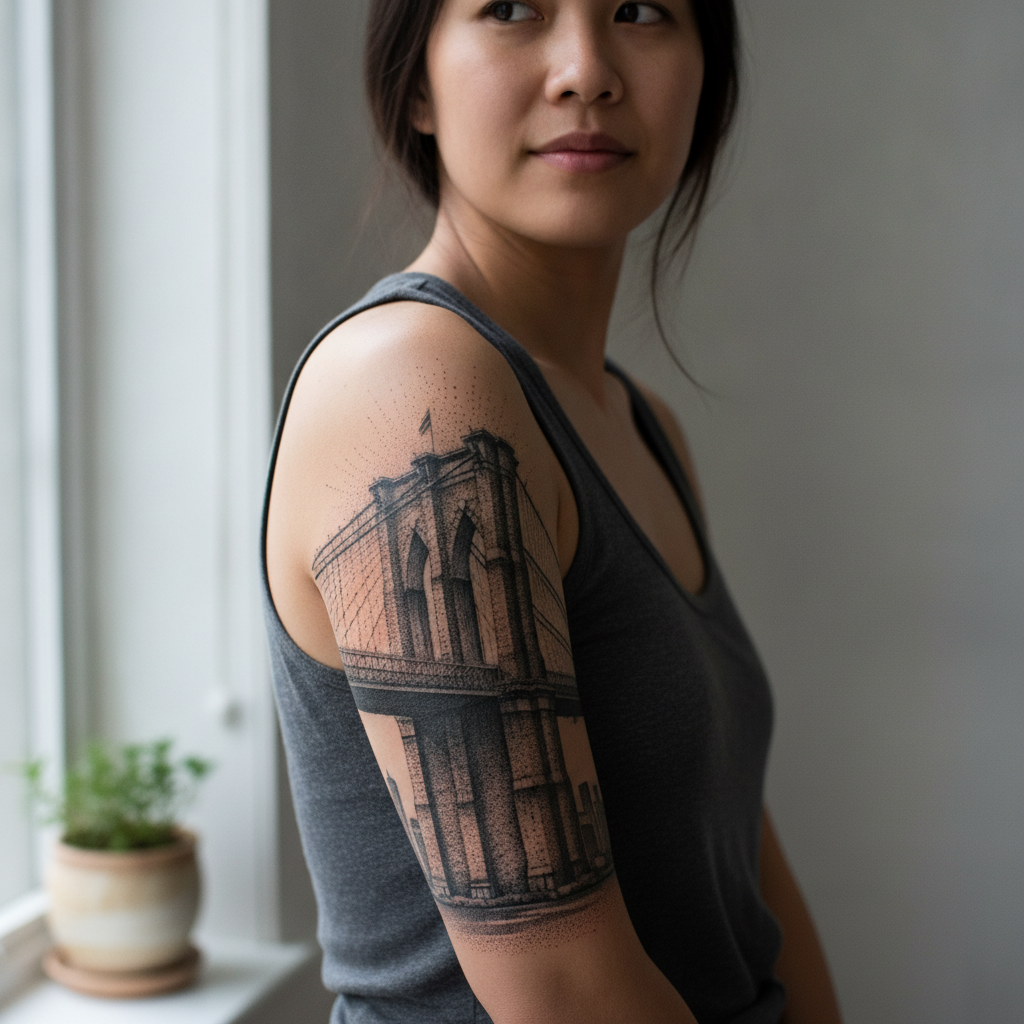
Scale matters here too. A full suspension bridge rendered small enough to fit on a wrist loses the cable detail that makes it recognizable, so the piece reads as a bump with wires. Give it room. A bicep wrap, a full forearm panel, or a thigh placement gives the artist enough length to let the cables stretch and the deck taper into perspective. Expect two to four hours of work for a well-rendered single-span bridge in fine-line, and five to eight hours in dotwork or heavier black-and-grey.
If you want multiple bridges (someone with ties to several cities), ask the artist to compose them as a continuous panel rather than as separate medallions. Three bridges stitched into one scene using shared water, shared sky, or shared cable lines will read as a story. Three bridges floating in isolated bubbles will read as a sampler.
Cityscapes and skylines without the clip-art trap
The most common failure mode in skyline tattoos is the clip-art skyline, where the city is reduced to five generic rectangles with a water tower on top. It is instantly readable as a tattoo of a skyline, but it does not read as any specific city, and that is a problem because the whole point of a skyline tattoo is to name a place.
To avoid this, work with your artist on two or three anchor buildings instead of trying to render the whole skyline. For New York, that is usually the Empire State, Chrysler, and One World Trade. For Chicago, the Willis, Hancock, and Tribune Tower. For Tokyo, the Tokyo Tower, Skytree, and Mode Gakuen Cocoon. Everything in between those anchors can be suggested with simpler block shapes because the viewer is reading the silhouette as a rhythm, and a few strong markers carry the identification.
The other thing that saves skyline work is weather and time of day. A skyline with a visible sun or moon, a layer of fog at the base, or a cross-hatched night sky above gives the piece atmosphere and depth. A pure outline skyline on blank skin usually looks unfinished within a year as the lines settle, because there is nothing holding the composition together. Add atmosphere at the design stage, not later as a cover-up.
Style and technique pairings
- Fine-line and single-needle: best for Gothic cathedrals, Art Deco details, isometric building studies. Expect to need a touch-up at year three to five. Fine-line on architecture is unforgiving if the artist is not practiced in straight lines over long distances.
- Dotwork and stippling: best for brick and stone textures, aqueducts, atmospheric cityscapes. Dotwork holds up better long-term than fine-line because the density can be built up to withstand ink spread.
- Blackwork and woodcut: best for silhouette-forward pieces, Gothic cathedrals in extreme contrast, brutalist monoliths. Woodcut-style hatching gives you the German Expressionist look.
- Neo-traditional and American traditional: skylines and bridges work surprisingly well in traditional framing with bold outlines and limited palette. Not for photorealism, excellent for iconography.
- Realism and micro-realism: possible for single buildings on larger placements. Not recommended for full skylines, which collapse into gray noise at micro scale.
Expect hourly rates of $150 to $300 for a competent artist in this specialty, with full-day sessions landing between $900 and $1,800. See the broader tattoo pricing breakdown if you are planning a multi-session piece.
Placement that respects the architecture
Vertical subjects want vertical placements. A cathedral spire down the outer forearm, calf, or spine will land cleanly. A cathedral jammed horizontally across a chest will fight its own geometry. Horizontal subjects (most bridges, most skylines) want long horizontal real estate: ribcage, collarbone to shoulder, across the lower back, or around a bicep.
Avoid high-movement areas for detailed architectural work. Fingers, inner wrists, hands, and feet all distort and fade faster than other placements, and detail-heavy architecture is exactly where that fade shows first. If you want hand or finger architectural work, commit to a stylized or silhouette approach rather than fine detail, and plan for touch-ups every two to three years.
Frequently asked
How many sessions does an architectural tattoo usually take? A single building in fine-line or dotwork is typically one session of three to five hours. A full skyline panel or a wrapped bridge piece is usually two to three sessions spaced four to six weeks apart. Large back pieces incorporating multiple structures can run five sessions or more.
Will the fine lines in an architectural tattoo blur over time? Fine-line architectural work does soften, particularly on areas with sun exposure or frequent friction. Plan on a touch-up at year three to five to crisp up the thinnest lines. Dotwork and heavier black-and-grey hold longer, often eight to ten years before any refresh is needed.
Can I combine a cityscape with other elements, like a date or coordinates? Yes, and it often strengthens the piece. Coordinates in a small serif or stencil font below a skyline, a date worked into the architecture, or a street name set into a subtle banner all add specificity without crowding. Keep the typographic element small relative to the architecture so the building stays the subject.
Do architectural tattoos work in color? They can, but most age best in black-and-grey. If you want color, use it as accent (a single warm window glow, a muted sunset gradient behind a skyline) rather than fully coloring the architecture. Color on brick and stone tends to flatten the depth that makes these pieces work.
How do I find an artist who actually specializes in this? Search Instagram tags like #architecturetattoo, #cathedraltattoo, and #cityscapetattoo, then look at the artist's healed work after six months, not the fresh photos. A clean fresh photo tells you nothing about whether the piece will survive. If the artist has a portfolio of healed architectural work that still reads clean, book them even if it means waiting six months.
What should I bring to the consultation? Two to four reference photos from different angles, a line drawing or architectural elevation if available, a rough size and placement in mind, and your budget. Expect to pay a non-refundable deposit of $100 to $300 at the consultation, which comes off the final tattoo cost.