cost guides
Dragon Tattoo Cost: Size, Style, and Session Pricing Guide
Dragon tattoos run $200 for a palm-sized piece to $8,000+ for a full back. Here is what size, style, and session count actually cost in 2026.

Dragons are one of the most requested large-scale designs in tattooing, and the price range is wider than almost any other subject. A small coiled dragon on the forearm might run $250 to $450 at a mid-tier artist. A full back piece in traditional Japanese irezumi style with color, clouds, and water finishes between $5,000 and $9,000 across six to ten sessions. The cost depends less on the dragon itself and more on how much skin it covers, what style you commit to, and who holds the machine.
What drives dragon tattoo pricing
Three things set the price. Size comes first, because dragons rarely work as tiny pieces. The design relies on flow, movement, and detail along the body of the beast, so most artists will push back if you ask for a dragon smaller than three or four inches. Below that scale the scales themselves start to blur, and the piece reads as a lizard or a worm. Second is style. A clean fine-line dragon takes fewer hours than a full-color Japanese dragon with cherry blossoms and crashing waves. Third is the artist, which is where the biggest swings happen.
Hourly rates for competent tattooers in major cities now sit between $180 and $280. Established artists with a recognizable style charge $300 to $500 per hour, and the small group of international dragon specialists charges $600 to $900 and books a year out. Shop minimums for a walk-in sit at $100 to $150, though no reputable artist will do a dragon as a walk-in. Expect to pay a $100 to $500 deposit before the first session, applied against your final total.
- Palm-sized dragon (3-4 inches): $250 to $500, one session
- Forearm dragon (6-8 inches): $600 to $1,400, one to two sessions
- Half sleeve dragon (shoulder to elbow): $1,500 to $3,500, three to four sessions
- Full sleeve dragon with background: $3,000 to $6,500, five to seven sessions
- Back piece dragon: $5,000 to $9,000, six to ten sessions
- Chest and shoulder dragon: $2,500 to $5,500, four to six sessions
Style changes the math
The style you choose moves the price more than most people realize. Japanese irezumi dragons, the long serpentine style with clouds, waves, and wind bars, are the gold standard for large dragon work and also the most expensive to execute properly. The reason is time. A traditional Japanese sleeve runs 25 to 40 hours of needle time because the background packs out solid and the color saturation requires multiple passes. If you want a traditional Japanese irezumi dragon done right, budget $4,000 to $7,000 for a sleeve.
Chinese dragons share the serpentine shape but tend toward more intricate scale work and less saturated backgrounds. They often cost a bit less than Japanese pieces, maybe 15 to 20 percent, because the artist is not laying down giant color fields. Western fantasy dragons with wings, armor plating, and a Smaug-style posture lean on realism techniques and sit in the $1,200 to $4,500 range depending on scale. Fine-line and minimalist dragons are the cheapest entry point. A single-line dragon on the ribs or forearm runs $300 to $700 and takes two to four hours. Black-and-grey realism dragons split the difference, usually $200 to $280 per hour for 8 to 20 hours of work.
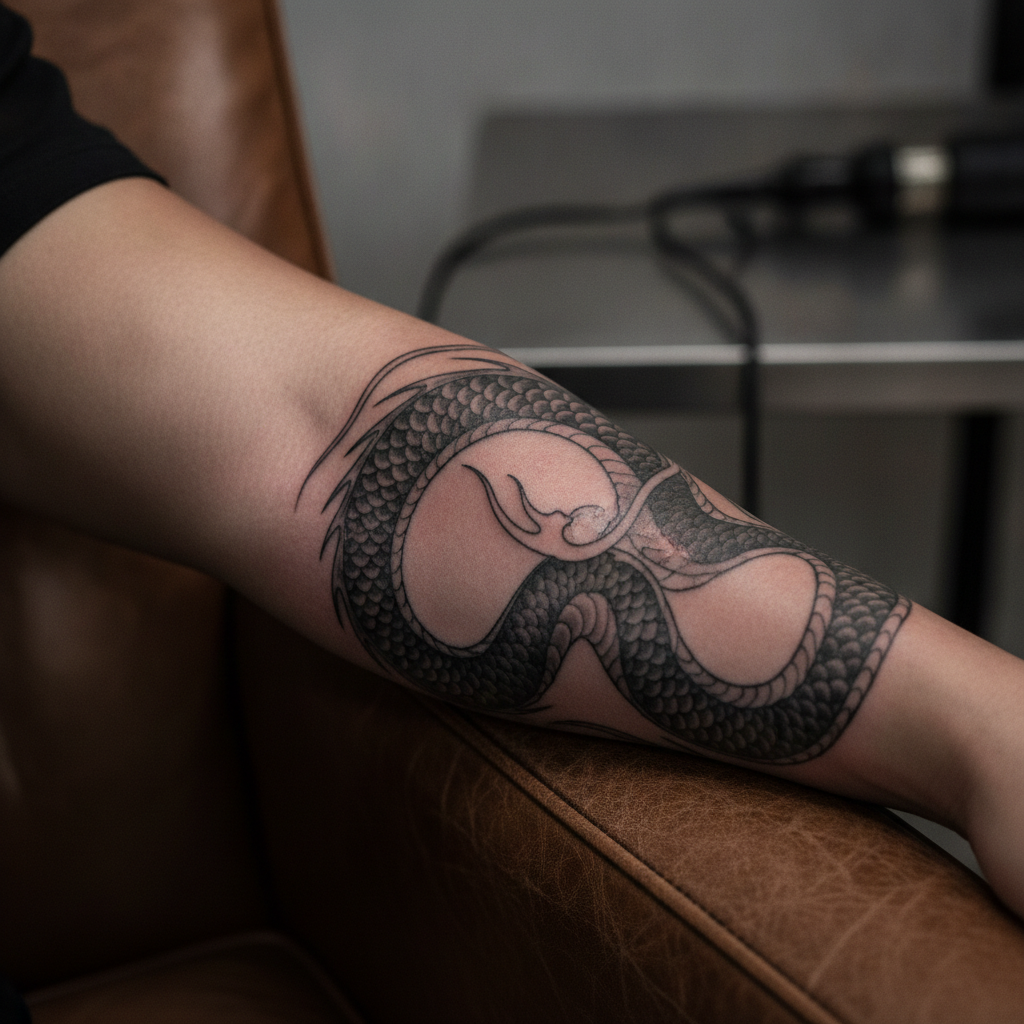
Color changes the quote too. Full-color dragons require more sessions than their black-and-grey counterparts because color packing is slower and the skin needs recovery time between passes. A color sleeve typically runs 20 to 30 percent more than the same design in black-and-grey. If you are budget-conscious, consider black-and-grey with a single color accent, like red eyes or a red orb in the dragon's claws. The pricing stays closer to black-and-grey rates while the piece reads as more dynamic.
Placement moves the number more than you think
A dragon on the ribs costs more per hour of actual work than the same dragon on the forearm, even though the shop rate is identical. The reason is time efficiency. Ribs are a brutal area to tattoo. Clients flinch, the artist takes more breaks, and sessions run shorter because pain tolerance caps the day. A ten-hour forearm dragon might stretch to fourteen hours on the ribs, which adds $700 to $1,200 to the total. The same applies to the sternum, the inner bicep, and anywhere near a joint. Our tattoo pain chart breaks down the painful zones in detail.
Placement also affects longevity, which is a hidden cost. Hands, fingers, and feet lose detail fast on a dragon design because the skin regenerates aggressively and the scales blur within three to five years. You will pay for touch-ups sooner. For a dragon meant to last twenty years without major rework, stick to the back, chest, thighs, shoulders, or the top of the forearm. Our back piece tattoo cost guide covers the pricing math for the most dragon-friendly canvas on the body.
Session count and what each one looks like
A dragon is not a one-session tattoo unless it is small. Larger pieces are built across multiple sits, each three to six hours long. The first session is usually linework only. The artist stencils the full design, often across a lunch break on day one, and then spends four to six hours laying down black outlines. You leave with a ghostly black dragon on raw skin and no color or shading yet. This session is the longest and typically the most expensive single sit, often $800 to $1,500 depending on scale.
Subsequent sessions handle shading, color packing, and detail. For a Japanese sleeve, expect two to three shading sessions and two to three color sessions, each three to five hours. Spacing between sessions matters. Most artists want four to six weeks between sits to let the previous work heal fully. Push shorter and you get muddy color. Push longer and you lose scheduling continuity. See how long between tattoo sessions for the full timing breakdown.
A full back dragon done right is a one-year project. Clients who try to compress it into three months almost always compromise the final quality.
Hidden costs most people forget
The posted hourly rate is not what you actually pay. Factor in the deposit, which locks your dates and gets applied to the final session, not the first one. Factor in the tip, which runs 15 to 25 percent on the total and is expected in US and most European studios. On a $5,000 sleeve, that is $750 to $1,250 on top. Factor in aftercare supplies, roughly $40 to $80 per session for Saniderm, unscented lotion, and antimicrobial soap.
If you travel for an artist, add flights and lodging across multiple visits. International guest artists charge their home-city rates but you cover their studio day rate at the hosting shop. Touch-ups two to three years in run $150 to $400 per session depending on how much needs sharpening. A dragon with heavy color saturation will need a touch-up by year five regardless of how well you cared for it. Budget for it from the start.
Where to save and where not to
The temptation with a big piece is to shop around for a cheaper hourly rate. This almost always costs more in the long run. A $160-per-hour artist who takes 30 hours to do what a $280-per-hour artist does in 18 hours ends up more expensive, and the result is weaker. Dragon tattoos live or die on linework consistency and color saturation, and the artists who do them well charge accordingly.
Where you can save is on size and complexity. A smaller dragon in black-and-grey with simple negative space backgrounds costs a fraction of a full-color Japanese sleeve and still reads as a committed piece. Skip the elaborate backgrounds if you are budget-constrained. The dragon itself is the subject. Clouds, waves, and wind bars are negotiable. Our hourly vs flat-rate tattoo pricing guide covers when to push for a flat rate on a defined piece.
Frequently asked
How much does a small dragon tattoo cost? A small dragon in the three to four inch range costs $250 to $500 at a mid-tier artist. Fine-line or single-needle versions sit at the lower end. Black-and-grey with any real shading pushes toward $500. Below three inches most artists will decline the work or warn you the detail will not hold.
Is a Japanese dragon tattoo more expensive than a Chinese one? Yes, usually by 15 to 25 percent for comparable size. Japanese irezumi dragons require solid background packing with clouds and waves, which adds hours. Chinese dragons tend toward more open backgrounds and lighter saturation, so they finish faster. The dragon figure itself takes similar time in either style.
How long does a full dragon back piece take? Six to ten sessions across six to twelve months, totaling 30 to 50 hours of needle time. The linework session alone runs five to seven hours. Shading and color packing span the remaining sessions, spaced four to six weeks apart. Pricing lands between $5,000 and $9,000 total depending on artist tier and style.
Do dragon tattoos require a lot of touch-ups? Color dragons need a touch-up around year five, costing $200 to $500. Black-and-grey dragons on well-placed areas like the back or thigh can go a decade before needing work. Hands, fingers, and feet need touch-ups every two to three years regardless of style. Factor one touch-up into the lifetime cost of any serious dragon piece.
Can I get a dragon tattoo done in one session? Only if it is small, under five inches, and in a lower-detail style like fine-line or minimalist blackwork. Anything larger needs multiple sessions. Attempting a full forearm dragon in one marathon sit produces fatigued skin, muddy color, and compromised linework. Reputable artists refuse these requests and the ones who agree are usually not the ones you want.
How much should I tip on a dragon tattoo? Tip 15 to 25 percent of the total, paid in cash at the end of each session rather than at the end of the whole project. For a $5,000 sleeve across six sessions, that is around $125 to $200 cash per sit. Our tipping guide covers the etiquette in detail, including international norms.