style guides
Japanese Irezumi Tattoos: Style Guide, Motifs, and Real Costs
Japanese irezumi runs $2,500 for a half sleeve to $20,000+ for a back piece. Here are the motifs, the real 2026 pricing, and how it ages over a decade.

Japanese irezumi is the most codified style in tattooing. It comes with a centuries-old visual grammar, strict motif rules, and one of the longest commitment timelines you will sign up for in modern ink. This guide covers what makes a piece authentically irezumi, what the motifs mean, what you will pay in 2026, and how the work ages over a decade on skin.
What Irezumi Means
The word irezumi translates to "inserting ink," and in Japan it refers to the full traditional approach: large-scale composition, defined background elements, and motifs drawn from Edo-period woodblock prints. A small Japanese-style koi on a wrist is not irezumi in the strict sense. Real irezumi pieces start at the half-sleeve scale and routinely run as full back pieces, full sleeves, and bodysuits.
Western artists often use "Japanese tattoo," "Japanese-style," or "Asian traditional" as broader umbrella terms. The technical difference matters when you book. A Japanese-style flash piece can be done in one session for a few hundred dollars. A true irezumi sleeve is a multi-year commitment built across 30 to 60 hours of needle time, with a planned narrative running across the limb. Knowing which one you want before you walk in saves the artist from explaining the gap.
The style is governed by composition rules that pre-date modern tattooing. Wind bars, finger waves, cherry blossoms, and clouds fill the negative space around the central motif. Backgrounds are part of the piece, not filler. An artist who skips the background or treats it as optional is not working in the tradition, regardless of how clean their koi looks.
Core Motifs and Their Meanings
Every major motif in irezumi carries a stable meaning. The koi swims upstream and represents perseverance, often shown climbing a waterfall toward becoming a dragon. The dragon itself is wisdom and protective strength, not destruction. Tigers represent courage and ward off bad luck and disease. Hannya masks depict a woman transformed by jealousy or grief and serve as a warning rather than a celebration.
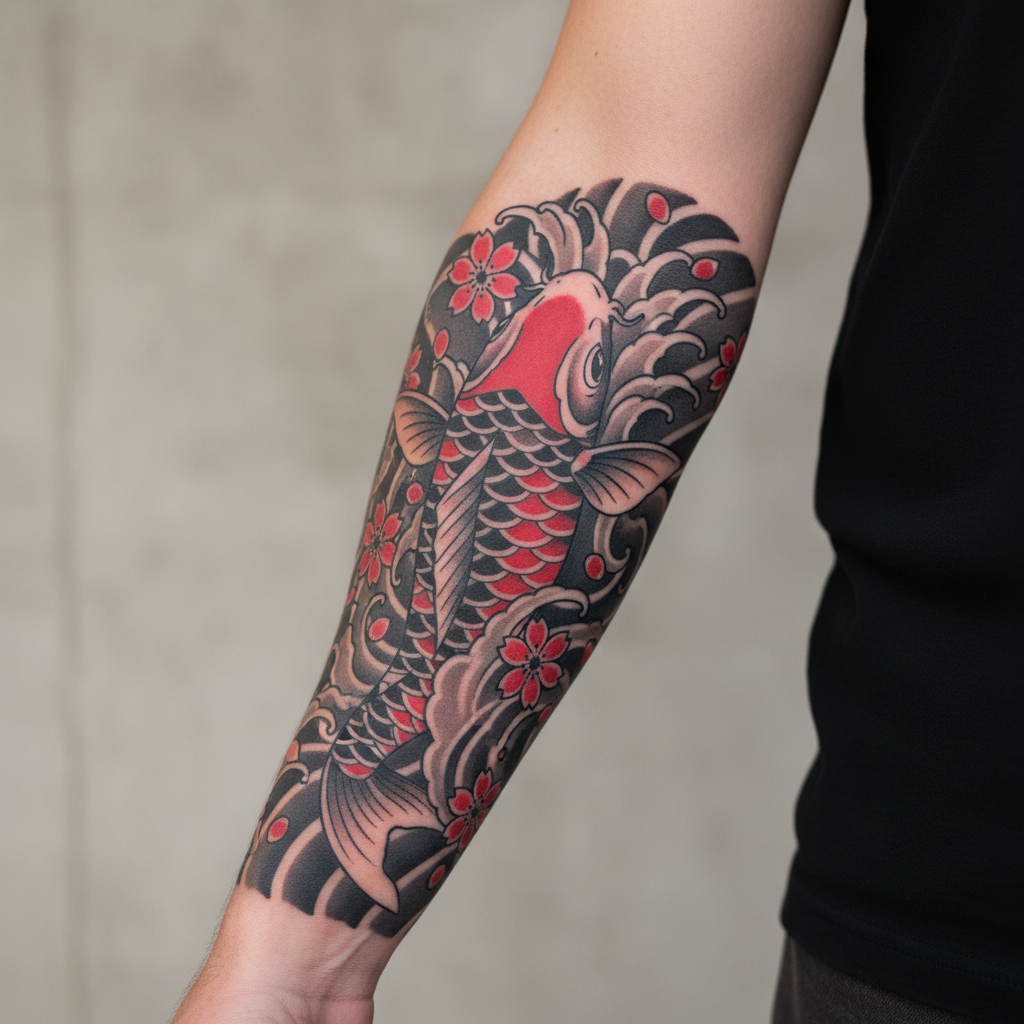
Flowers carry season and emotion. Cherry blossoms mark impermanence and beauty that does not last. Peonies signal wealth, prosperity, and bravery in love. Chrysanthemums tie to longevity and the imperial line. Maple leaves carry quiet sentiment and the end of summer.
Mixing motifs the wrong way is a tell. A koi swimming downstream does not mean the same thing as one swimming up. A dragon paired with the wrong cloud formation breaks the visual sentence. Good Japanese-style artists will refuse certain combinations, and that is a green flag. You can lean on a deeper read of how style commitment shapes price in our tattoo pricing breakdown when you start sizing a piece.
Tebori vs. Machine: How It Gets Applied
Traditional Japanese tattooing used tebori, a hand-poked technique with a long bamboo or metal rod tipped with needles. Color was packed in by hand, one push at a time. Today, almost no studios outside a handful of Japan-based masters still work tebori for full pieces. Most modern Japanese-style work is done with rotary or coil machines, often by artists who trained in Japan or apprenticed under Horishi (master) lineages.
Machine application is faster, cheaper, and easier on the artist's hand, and the visual result on healed skin is nearly identical for most viewers. Pure tebori has a softer color saturation and a distinctive shading texture that machine work does not perfectly replicate. If full tebori is the goal, expect to travel, expect a waitlist of one to two years, and expect rates well above your local studio's hourly ceiling.
A hybrid approach is common: outlines done by machine, color packed by tebori. This blends speed with the traditional texture. Ask the artist directly during consultation, since few list their technique on Instagram.
What Irezumi Costs in 2026
Pricing scales with scope, artist tier, and geography. A small Japanese-style flash piece runs $250 to $600. A half sleeve in a full traditional treatment runs $2,500 to $6,000 across three to six sessions. A full sleeve runs $5,000 to $15,000 across 20 to 40 hours. A full back piece runs $7,000 to $20,000 across 30 to 60 hours.
Top-tier Japanese-style artists in New York, Tokyo, and London charge $300 to $500 per hour. Mid-tier artists with strong portfolios run $180 to $280 per hour. Apprentices and emerging artists doing Japanese flash sit at $120 to $180 per hour. For multi-session projects, most studios collect a deposit per session, often $200 to $500, applied to that session's total. The mechanics are spelled out in our tattoo deposit guide.
- Half sleeve: $2,500 to $6,000 across 3 to 6 sessions
- Full sleeve: $5,000 to $15,000 across 20 to 40 hours
- Back piece: $7,000 to $20,000 across 30 to 60 hours
- Bodysuit: $25,000 to $80,000+ across 2 to 5 years
The hidden cost is time. A back piece is rarely done in fewer than 18 months. Travel to a Japan-based master adds flights, lodging, and time off for each session. Budget the trip as part of the piece, not on top of it.
Healing, Aging, and Long-Term Care
Large Japanese pieces are healed in sections. Each four to six hour session goes through the full four-week healing cycle covered in our tattoo healing timeline guide. Plan for a peeling and itching phase running roughly day five through day fourteen, and avoid sun, soaking, and friction over fresh sections for at least three weeks.
Color packing in saturated reds and yellows fades faster than black outlines. The classic black-and-grey wave-and-cloud background holds up for decades with minimal fade. Saturated peonies and the red highlights in koi scales are the elements most likely to need a touch-up at the ten-year mark. Sunscreen is the single biggest factor in how a Japanese piece looks at year fifteen, and SPF 50 mineral applied daily over healed work pays compounding dividends.
Ink migration in long thin lines, such as the spines of finger waves, is normal and adds character rather than blur. Bold solid blacks, common in dragon scales and Hannya hair, may need a refresh around year twelve as the ink settles deeper into the dermis.
How to Pick a Japanese-Style Artist
Look at healed portfolio shots, not fresh ones. Fresh ink looks crisp on every artist's Instagram. Healed work at the two-year mark reveals who understands ink deposit and who is overworking the skin. Ask to see at least three pieces photographed more than a year after the final session.
- Strong sign: backgrounds drawn first, then motifs placed within them
- Strong sign: artist refuses certain motif combinations on cultural grounds
- Red flag: only fresh-ink shots in portfolio
- Red flag: pricing by piece without a discussion of session count
- Red flag: no consultation requirement before booking
A consultation should run 30 to 60 minutes. Bring reference images, but expect the artist to redraw rather than copy. Custom drawing time is built into the deposit on most large pieces.
Frequently asked
Is irezumi still illegal in Japan? Tattooing in Japan was legally restricted for decades and operated in a grey area. A 2020 Supreme Court ruling formally established that tattooing is not the practice of medicine, which legalized the trade. Many onsen, gyms, and public pools still refuse entry to visibly tattooed guests as a private policy, and that is unrelated to the legality of getting the work done.
How long does a full Japanese sleeve take? A full Japanese sleeve typically runs 20 to 40 hours of needle time spread across six months to two years. Most artists prefer four to six hour sessions, scheduled four to six weeks apart to allow each section to heal before the next.
Can I mix Japanese motifs with other styles? Mixing irezumi motifs with neo-traditional, blackwork, or fine-line elements is common in Western studios. Purists in the Japanese tradition will decline mixed-style work. If you want a clean fusion piece, look for artists who openly describe their work as Japanese-influenced or Asian-traditional rather than irezumi.
Does tebori hurt more than machine? Tebori pain is different rather than worse. The hand-poking sensation is described as a slower, deeper press compared to the rapid vibration of a machine. Long sessions are more about endurance than spike pain, and most clients report the experience as more meditative than expected.
Will a Japanese tattoo offend anyone in Japan? Wearing motifs respectfully and getting work from a serious artist rarely offends. Cultural sensitivity is more about avoiding motifs tied to organized crime imagery and not photographing your back piece at public temples. When in doubt, ask the artist about appropriate context.
How do I prepare for a long Japanese session? Eat a full meal two hours before, hydrate the day before, and bring high-protein snacks for the session. Avoid alcohol for 48 hours before. Wear loose clothing that exposes the area without needing to be removed. Sessions over four hours benefit from a long lunch break in the middle.


