style guides
Minimalist Tattoos Style Guide: Fine Lines, Small Scale, Long Wear
Minimalist tattoos lean on thin single-needle lines, negative space, and restraint. Here is how the style actually ages, what it costs, and when it is the wrong pick.

Minimalist tattoos look like the easy pick. One thin line, a small shape, a few millimeters of ink and you walk out in under an hour. The style has owned social feeds for close to a decade now because it photographs well, hides under a watch band, and costs less than most sleeves. The catch is that minimalism is unforgiving. Every design choice shows, every needle wobble shows, and every aging quirk of your skin shows twice as loudly as it would on a saturated traditional piece.
What actually counts as minimalist
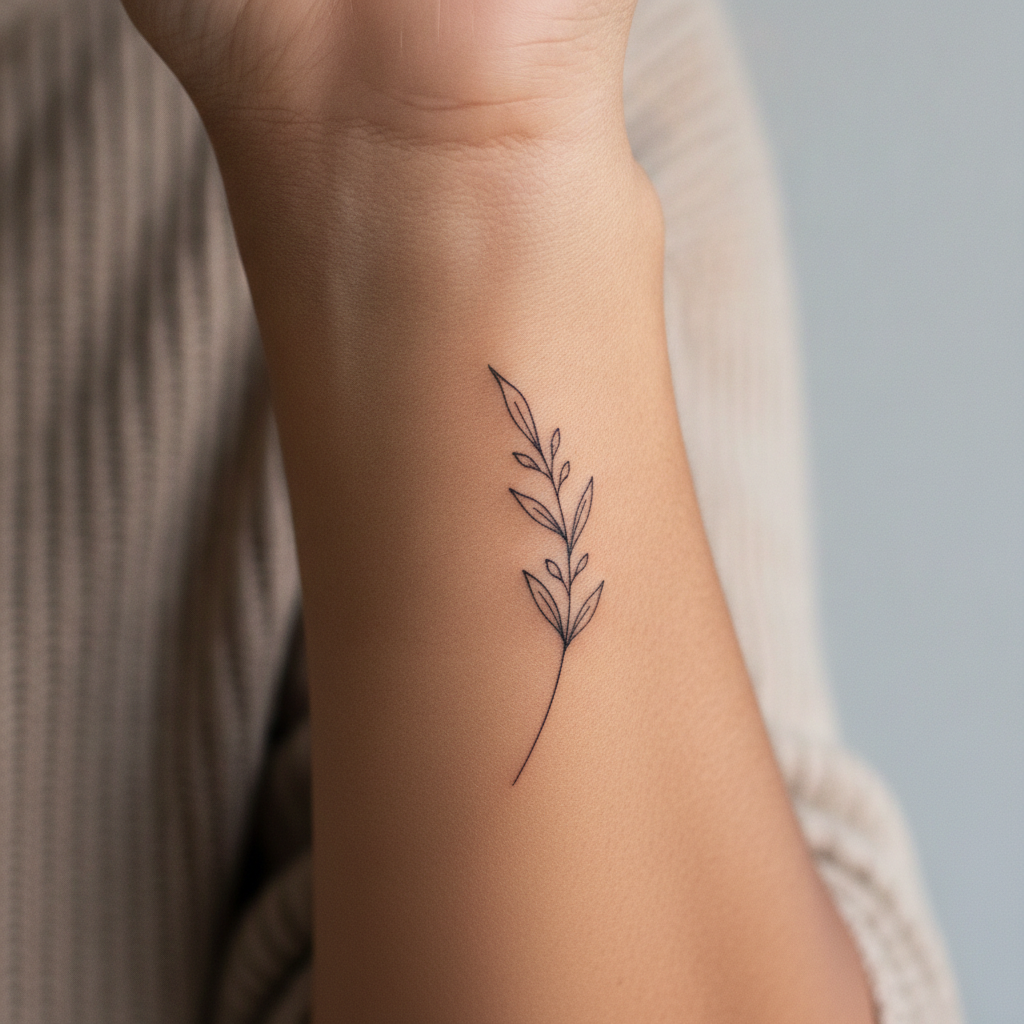
Minimalist tattoos are defined by subtraction, not by subject. The style strips a design down to its smallest readable form, usually using a single thin line of black ink, little to no shading, and a lot of surrounding negative space. Typical line weights sit between 0.25mm and 0.5mm, applied with a single-needle or 3RL (three-round-liner) grouping. Line weight is the single biggest tell of the style. A sprig of rosemary rendered in a 7RL liner is a fine-line tattoo. The same sprig in a 1RL at a fraction of the pressure, with gaps between the leaves and no fill, is minimalist.
Subject matter follows the technique. Common choices include small botanicals, geometric shapes, single-word script, tiny animals, abstract line drawings, and simplified icons like crescents, matches, or paper airplanes. The point is that one glance should read the image. If a viewer has to lean in and parse what the shape is supposed to be, it has drifted from minimalism into illustrative or micro-realism territory. For a side-by-side on where the lines fall, our fine line tattoo style guide covers the next tier up in detail and line weight.
How minimalist tattoos age
This is the part most first-timers underprice. Thin ink laid superficially heals cleaner than heavier work, but it also has less pigment reserve. Over five to ten years, a hairline black line will soften and spread slightly as the body breaks down ink particles and pushes them into surrounding tissue. On a bold traditional outline, that spread is cosmetically invisible. On a 0.3mm line, it can look like a smudge.
Three variables drive how fast a minimalist tattoo loses its sharpness.
- Placement. High-friction, high-sun areas (hands, fingers, feet, inner forearm facing up) blur faster. Protected areas (inner bicep, ribs, upper back) hold crisper lines for longer.
- Skin type. Thinner, drier skin tends to hold fine lines better than oily or very elastic skin. Stretchy areas like the stomach or outer thigh pull on healed lines over time.
- Artist skill. Depth control is everything. Lines packed slightly too deep bleed into the dermis and widen inside a year. Lines packed too shallow fall out and need touch-ups.
A well-executed minimalist piece on a protected placement typically needs its first touch-up around year five to seven. A rushed single-needle finger tattoo can need one at eighteen months. If you are curious about the economics of that reality, our tattoo touch-up cost guide breaks down shop pricing.
Placement choices that actually last
Minimalist work rewards placements that stay out of the sun and off friction zones. Inner forearm, inner bicep, back of upper arm, upper rib, shoulder blade, sternum, and ankle (inside, not top) all give the ink a stable canvas. The nape of the neck under the hairline is another underrated option because clothing and hair shield it from UV.
Placements that look great on day one but age poorly for the style include the top of the hand, the sides of the fingers, the palm, the top of the foot, and anywhere the skin creases hard. Palm tattoos in particular reject ink aggressively because the skin layer there sheds on a short cycle. If a palm tattoo is the goal, read our palm tattoo cost guide first because the retouching cadence changes the real cost significantly.
What minimalist tattoos cost
Pricing is the one place the style is actually friendly. Most shops charge a minimum fee of $80 to $150 for any tattoo, and a true minimalist piece usually hits exactly that minimum. Small flash from a mid-tier artist runs $100 to $200. Custom work from a known fine-line specialist runs $200 to $500 for a palm-sized design. Named artists with waiting lists charge $400 to $800 and up for the same square inch, mostly because the booking slot is scarce rather than because the ink takes longer.
Expect a 15 to 20 percent tip on top. If the artist drew a custom design from a short brief, tip toward the top of that range. Our how much to tip tattoo artist breakdown has the full etiquette.
When minimalism is the wrong call
Minimalist is a poor fit when the subject carries meaning that depends on detail. A portrait, a specific animal with distinctive markings, a complex symbol, or anything representing a person usually loses the point when stripped to lines. It is also a weak choice as a cover-up because thin new ink cannot hide thick existing ink without heavy shading, which breaks the style.
If the goal is a tattoo that looks dense and visually loud at six feet, pick a different lane. Blackwork, traditional, and neo-traditional all read from across a room. Minimalist tattoos are intimate pieces. They reward close looking and sit quietly the rest of the time.
Frequently asked
How long does a minimalist tattoo take to get? Most minimalist pieces take 20 to 45 minutes in the chair, plus 15 to 30 minutes of stencil placement and prep. A simple single-line design under two inches can be done in a lunch break. Larger compositions with multiple elements can run 60 to 90 minutes.
Do minimalist tattoos hurt less? Pain from a tattoo is driven mostly by placement and session length, not line weight. A single-needle liner on the ribs still hurts because the ribs are a thin-skinned, bony area. The upside is that sessions are short, so total pain exposure is lower than a four-hour sleeve session on the same spot.
Can minimalist tattoos be done in color? Yes, but the style gets harder to execute. Thin color lines fade faster than thin black lines because red, yellow, and light blue pigments break down under UV sooner. If color is important, muted earth tones packed with a single-needle hold up better than bright primaries. Many clients end up adding small color accents around a black line structure.
Will my minimalist tattoo need touch-ups? Probably, eventually. Plan on one touch-up between years five and seven for a well-placed piece, sooner for hands, fingers, or feet. Most reputable artists offer a free touch-up in the first six months to catch any ink that drops out during healing, which is separate from longer-term maintenance.
What is the smallest tattoo an artist will actually do? Industry norm is roughly a half inch for a readable shape. Anything smaller than that tends to blur into a dot within a few years because the body cannot distinguish individual micro-lines once they soften. Reputable artists will often talk clients up to a slightly larger size for longevity.
Is minimalist a good first tattoo style? It can be, with one caveat. The low commitment is appealing, but minimalist pieces leave nothing to hide behind, so artist choice matters more than it does for bolder styles. Pick an artist whose healed portfolio (not just fresh photos) shows crisp, non-blurry fine lines at the two-plus year mark.