cost guides
Tattoo Touch-Up Cost: When It's Free and When You'll Pay
Tattoo touch-ups run free to $200+ depending on timing, fade type, and shop policy. Here's when your artist comes back for free and when they'll quote you.

A touch-up is the closest thing tattoos have to a warranty. Most reputable shops will refresh light spots and patchy line work for free within a window, usually three to six months from your original session. After that window closes, you are paying. The pricing has its own logic, and it is not the same logic as a fresh tattoo.
What counts as a touch-up
A touch-up means returning to an existing tattoo to fix specific problem areas: a line that did not take, a patch of color that healed unevenly, a section that faded faster than the rest. The artist works only on the affected spots, not the whole piece. Most touch-ups take 15 to 60 minutes, even on large pieces, because the rest of the design is left alone.
Touch-ups are different from cover-ups, refreshes, and reworks. A cover-up tattoo hides an old design under a new one, which is a full custom tattoo with cover-up complexity priced in. A refresh re-saturates the entire tattoo and effectively reprices it as a new session. A rework is a partial redesign. Touch-ups are the cheapest of the four because the surface area is small and the design work is already done.
The other thing touch-ups are not is preventive maintenance. Healthy healed tattoos do not need yearly touch-ups. If an artist tells you that, walk out. A well-executed tattoo on protected skin can hold sharp for ten or fifteen years before you need to think about line reinforcement.
When touch-ups are free
Almost every reputable shop offers a free touch-up window for healing-stage imperfections. Industry standard is three months from the original session date, though many shops extend it to six months and a few will go a full year for larger pieces. The clock starts the day you got tattooed, not the day you noticed the problem.
Free touch-ups cover what the artist would consider their own quality control: a saturation gap, a soft line that did not take, a small color drop-out, a patchy spot in solid black. They do not cover damage from your aftercare mistakes. Scabs you picked, sun exposure during week one, soaking in a chlorinated pool before the wound closed, sleeping on it for eight hours straight every night, these are all on you. Most shops will still touch up the result, they will not do it for free.
A few rules that make a touch-up free at most shops:
- Book within the stated window, usually three to six months
- Bring proof of the original session if you no longer have it in the booking system
- Show up healed (skin should be settled, no active peeling or rawness)
- Same artist when possible, since they know how the original ink behaves
If you waited longer than the free window or you changed artists, expect a quote. The good news is that quote is usually small compared to fresh work. The broader logic in tattoo pricing explained still applies here, scaled down.
What you'll pay if it's not free
Paid touch-ups follow one of three pricing models, and which model your artist uses depends mostly on the shop. Here is the rough math.
- Flat fee touch-up: $50 to $150 for small to medium pieces. This is the most common pricing for a single 30 to 60 minute session covering one or two spots. Many shops have a fixed touch-up rate that ignores their hourly.
- Discounted hourly: 50 to 75 percent of the artist's normal hourly rate. Used when the touch-up covers multiple zones or runs longer than an hour. A $200 per hour artist might charge $100 to $150 per hour for touch-ups.
- Shop minimum applies: $80 to $200 minimum for any tattoo work, including a five minute fix. This is more common at high-end shops where artist time is the bottleneck. The minimum keeps your tiny touch-up from displacing a full session.
For a typical small-to-medium tattoo more than a year old, budget $80 to $200 for the touch-up. Sleeves, back pieces, or full color tattoos run higher because there are more zones to refresh. A sleeve touch-up across an entire arm easily hits $300 to $600 if you are refreshing color saturation across the whole piece.
What drives the price
Five factors push a touch-up quote up or down, regardless of which pricing model the shop uses.
Age of the tattoo. Anything older than two years usually needs more work because the lines and saturation have softened evenly across the piece. Color tattoos older than five years often need full re-saturation, which is not really a touch-up anymore.
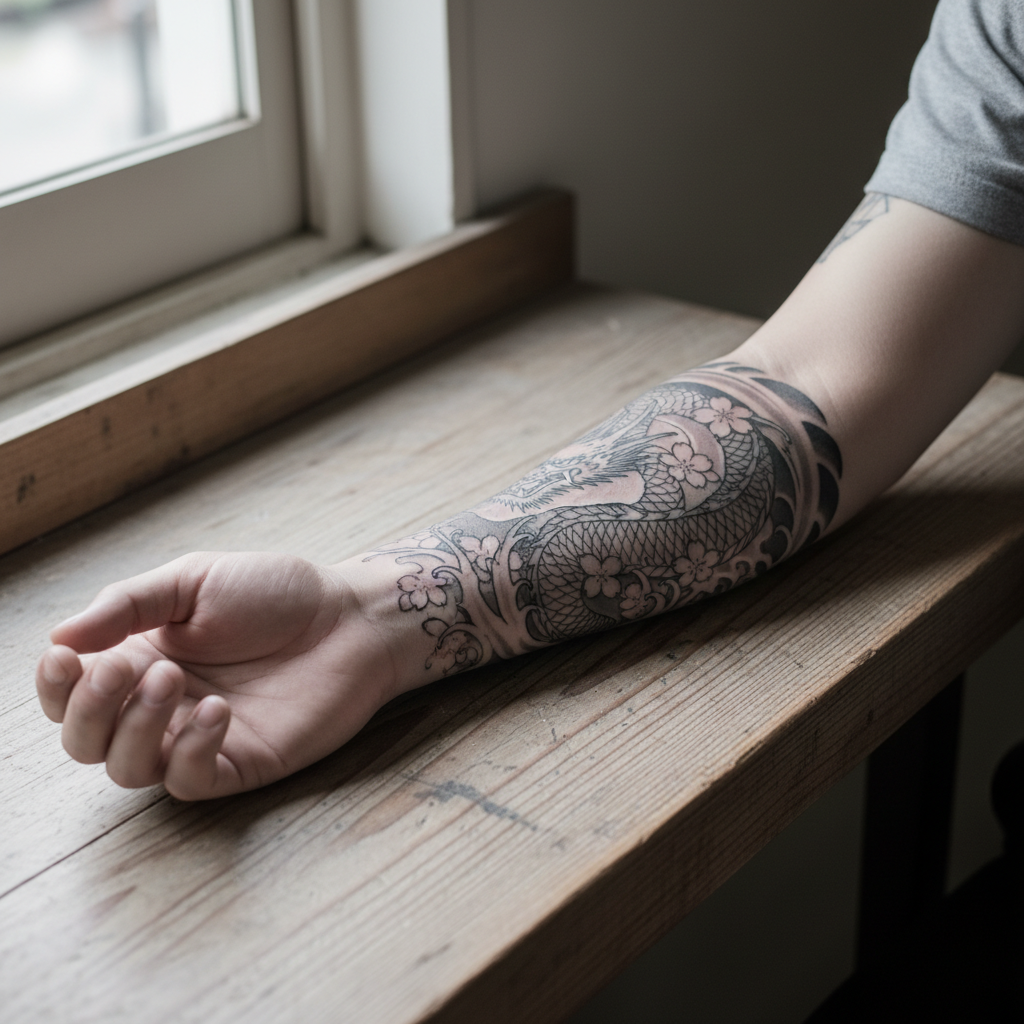
Style. Fine-line and single-needle tattoos touch up faster but cost the same per minute, because the artist needs the same focus to match the original needle work. Bold traditional and Japanese pieces with heavy black are the easiest to refresh and the cheapest per square inch. Watercolor and pastel color pieces are the most expensive because the artist has to remix the original palette by eye.
Same artist or new artist. Your original artist already has your design history, often the stencil, and sometimes leftover ink mix from your session. A new artist has to color-match from photos and may charge 25 to 50 percent more for the matching work. Stick with the original artist when possible.
Skin tone and placement. Darker skin and high-friction areas (palms, fingers, feet, inner lip) lose ink faster and may need more aggressive re-packing. Both increase touch-up time and cost. The same is true for skin that did not heal flat the first time, where the artist has to work around scar tissue.
Sun exposure history. If your tattoo faded because of UV damage rather than normal settling, the artist may insist on a fade evaluation and a longer session to even out the result. Some shops will refuse touch-ups on heavily sun-damaged tattoos and recommend a full refresh instead, which is priced as a new session.
When a touch-up isn't enough
Sometimes what you want is not a touch-up. If more than 30 to 40 percent of the surface needs work, you are looking at a refresh, not a touch-up, and the cost jumps to fresh-session pricing. The line is usually drawn by the artist: if they cannot finish the work in 60 to 90 minutes, they will quote it as a new session.
Signs that you need more than a touch-up include lines that have blurred together (called blowout when it happens during healing, fade when it happens slowly over years), color that has shifted to a different hue rather than only lightening, and any area where the original design has lost its readable shape. For those cases, a refresh or a partial cover-up makes more sense than chasing the original.
How to know your tattoo needs one
Healed tattoos can look slightly different from fresh ones, and that is not a defect. Some patchiness in the first six to eight weeks is normal during the healing timeline. Wait until your tattoo is at least eight weeks healed before judging whether it needs work. The dull cloudy phase in weeks two through six can mask the final result.
After two months, look at your tattoo in good natural light. Lines should be crisp and continuous, color should be saturated and even, and the design should match the stencil you signed off on. If any of those three fail, book the touch-up. If all three pass, do not invent reasons to go back in. Every needle pass adds trauma, and chasing perfection through repeated touch-ups can blur a clean piece.
Frequently asked
Are touch-ups always free?
No. Most shops give you a free window of three to six months from your original session for healing-stage gaps. After that window closes, or if the issue traces back to aftercare, you pay. Free touch-ups also assume you go back to the same artist or shop where you got the original work.
How long after my tattoo can I get it touched up?
Wait at least six to eight weeks. Most artists will not touch up a tattoo until it is fully healed. Going in too early can stress the still-healing skin and lead to worse results than waiting.
Will a touch-up hurt more than the original?
Usually no. Touch-ups are shorter and cover smaller areas. The skin can be slightly more sensitive because it has scar tissue from the original session, but the overall experience is far easier than a fresh tattoo.
Can a different artist touch up my tattoo?
Yes, though most artists prefer not to touch other artists' work. If you go to a new artist, expect to pay more, expect them to take reference photos of the original, and accept that color matching across two artists is rarely perfect.
How often should I expect to touch up a tattoo?
A well-executed and well-cared-for tattoo can go a decade or more without needing work. Aggressive sun exposure, friction placement, and darker skin tones can shorten that to three to seven years. There is no schedule, only condition. Look at the tattoo, not the calendar.
Should I tip on a touch-up?
Yes, if there was a charge. Standard tipping logic applies: 15 to 25 percent of the touch-up fee. If the touch-up was free, a cash tip of $20 to $40 is good etiquette for a short session and shows respect for the artist's time.


