cost guides
Back Piece Tattoo Cost: What a Full Back Tattoo Costs in 2026
A full back piece in 2026 runs $4,500 to $20,000 across eight to twelve sessions. Here is what drives the price and how to keep it reasonable without cutting corners.

A back piece is the largest single canvas in tattooing, and the price reflects every hour the artist spends on you. Most full backs in 2026 cost between $4,500 and $20,000 in the United States, spread across six to twelve sessions over six months to two years. The real number depends on style, density, color load, and which artist you book, not on any flat rate a shop quotes at consultation.
What a back piece actually costs in 2026
Hourly rates from mid-level resident artists in the US sit between $150 and $250 per hour for back work, with senior artists at established studios charging $250 to $450 per hour. A back piece eats 30 to 80 hours of needle time depending on size and detail. That puts the working math at roughly $4,500 on the floor for a sparse linework back from a resident, $8,000 to $14,000 for a mid-density piece from a strong mid-tier artist, and $18,000 to $40,000 for a fully rendered back from a name artist in New York, Los Angeles, or Tokyo. Add 20% on top for tipping at the end of each session, since tipping per session is the norm and not a one-time gesture at the final reveal. Most clients pay session by session in cash or card, with the non-refundable deposit covering the artist's design time and first session block.
How session count and length drive the price
Back pieces run on long sessions because the artist needs to keep stylistic consistency across panels of skin that won't be touched again for weeks. A standard session for back work is four to six hours of needle time, plus 30 to 60 minutes of stencil application and breaks. Most artists cap one sitting at six hours because the skin starts swelling and rejecting ink reliably past that point. Eight to ten sessions is the sweet spot for a full traditional or neo-traditional back, while a heavily rendered Japanese back piece often runs twelve to twenty sessions when the artist works tebori-style or layers color slowly. Tighter scheduling does not shorten the total. Skin needs three to five weeks between sessions to heal enough for the artist to safely tattoo over an adjacent panel, so most back pieces span a full calendar year minimum from first session to final touch-up.
How style changes the bill
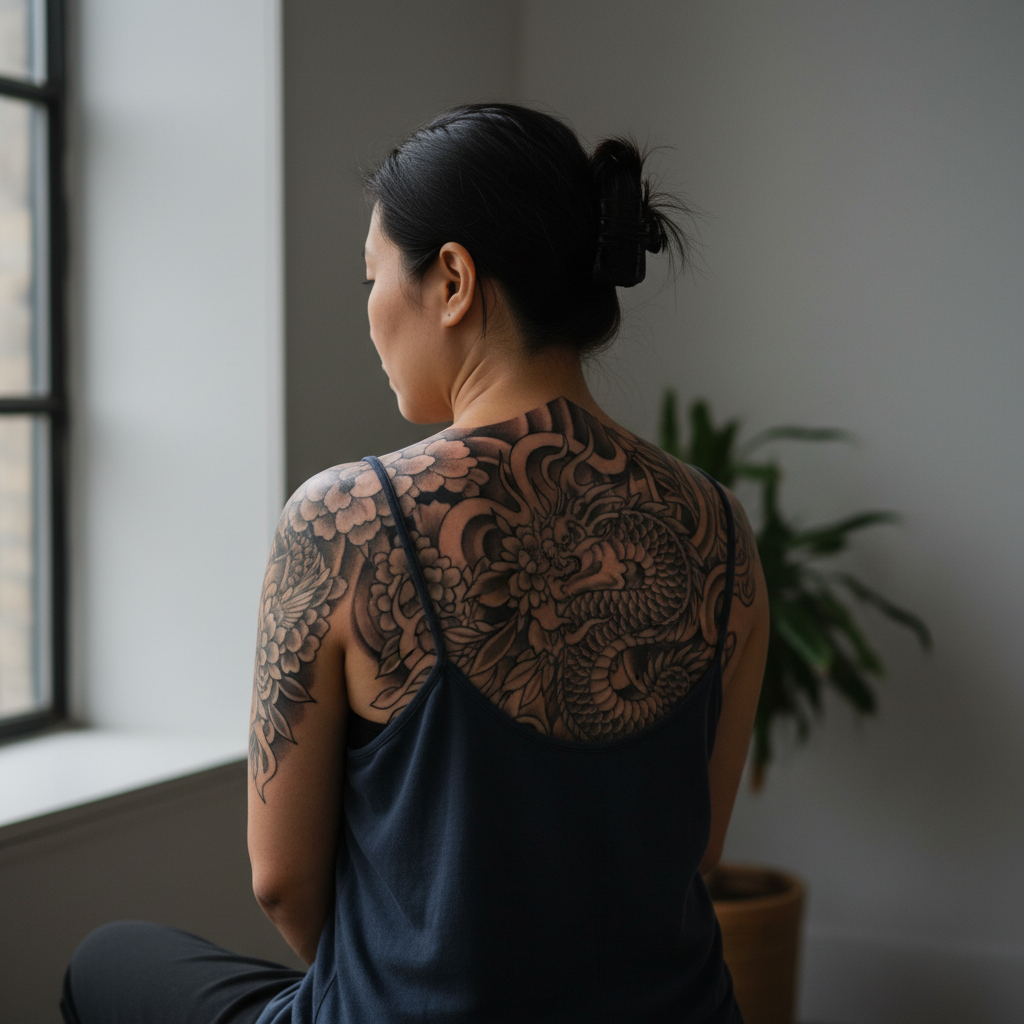
Style is the biggest single lever on price after artist tier. A Japanese irezumi back piece sits at the top of the cost ladder because the style demands full background work, water and wind elements, and saturated color across the entire panel. Expect $12,000 to $30,000 for a quality irezumi back from a specialist in the US or Japan, with Tokyo masters charging closer to ¥1.5 to ¥3 million as a flat commission. A blackwork back piece runs cheaper per session because the artist uses fewer needle changes and skips color packing, but density still drives total hours. Fine line and minimalist back pieces are the cheapest option at $3,500 to $7,000, though they are also the riskiest long-term since fine lines blur over a decade on the broad, mobile skin of the back. Realism back pieces, especially photo-realistic portraits or landscape compositions, fall between irezumi and blackwork in price but require artists with very specific portfolios.
What separates a $5,000 back from a $20,000 back
The price gap between a budget back piece and a high-end one comes down to four things, not artist ego:
- Artist tier and waitlist, with name artists at established shops charging two to three times what a strong resident charges per hour
- Density of detail, since a back panel filled edge-to-edge with shading and color takes twice the hours of a centered single subject on bare skin
- Color load, because each color requires its own needle changes, mixing time, and saturation passes
- Custom design depth, with fully custom pieces requiring 10 to 40 hours of unpaid design time that gets baked into the deposit or hourly rate
A budget back is usually a single bold subject on plain skin from a competent resident, finished in six sessions and held together by strong linework. A high-end back is a fully composed scene with background, multiple subjects, color rendering, and design revisions that took the artist a month to draw before the needle ever touched skin. Both can be excellent. They are not the same product.
Hidden costs people forget
Travel and lodging are the most underestimated line item for a destination back piece. Booking a back piece with a Tokyo, London, or LA artist usually means three to six trips for the full commission, since most artists won't condense the work into back-to-back days. Budget $1,500 to $4,000 per trip in flights and hotels on top of the tattoo cost itself. Touch-ups are another cost most clients don't price in. Most back pieces need a touch-up session 12 to 18 months after completion to refresh saturation in spots that healed lighter, and that session runs at the artist's full hourly rate. Color back pieces in particular benefit from scheduled touch-ups every five to seven years to stay punchy, and that maintenance cost compounds over the life of the piece. Lost work income matters too. Each session leaves you uncomfortable sitting upright and unable to sleep on your back for five to seven nights, which is worth modeling into the budget if you're hourly or self-employed.
How to keep the price reasonable without cutting corners
Booking a strong resident artist two to three years past apprenticeship completion is the single biggest cost saver on a back piece. Their hourly rate is half of a name artist's, and their portfolio is usually sharp enough for a back commission if you vet it carefully across at least five completed large pieces. Keeping the design to a single style and a single color palette is the second biggest lever, since stylistic complexity multiplies session count. Going black and grey instead of full color cuts roughly 30 to 40% off the total cost, both because color packing takes longer and because color saturation requires more aggressive needle work. Booking longer sessions when your schedule allows it reduces the per-session setup overhead some artists charge on top of hourly rates. And if you live in a high-rate city, consider a road trip to a strong mid-tier shop in a lower-cost market, which can save $3,000 to $8,000 across the full commission without losing artist quality.
Frequently asked
How long does a full back piece take to finish? Most back pieces take 12 to 24 months from first session to final touch-up. The actual tattoo time is 30 to 80 hours spread across six to twelve sessions, with three to five weeks of healing between each session. Plan for a calendar year minimum, and don't book the commitment if you can't keep the rhythm.
Can I pay for a back piece in installments? You pay per session, which is the natural installment plan. Each session ends with payment for the hours worked that day plus the tip, so a $12,000 back piece is effectively eight payments of $1,500 spaced across the year. Most artists do not offer formal financing, and almost none accept post-dated payment after the work is done.
Does a back piece hurt more than a sleeve? The spine, ribs, and lower back sit at the high end of the tattoo pain map, with the upper back and shoulder blades sitting in the mid-range. Most clients describe back sessions as more endurance-heavy than sleeve sessions because of the duration, not the per-minute intensity. Eating beforehand and pacing breaks matters more than raw pain tolerance.
Is it cheaper to get a back piece overseas? Tokyo, Bali, and Mexico City all have credible scenes with strong artists at lower hourly rates than US name artists, but trip cost usually closes the gap. A back piece in Bali might cost $5,000 in artist fees but $4,000 in flights and lodging across multiple trips, putting the all-in number close to a domestic mid-tier commission. The exception is Japan, where booking a true tebori master is a stylistic decision more than a financial one.
What's the deposit for a back piece? Deposits for back pieces typically run $500 to $2,000, depending on artist tier and how much custom design work is involved. The deposit is non-refundable and gets credited against either the first session or the final session, depending on the artist's policy. Read the deposit terms before paying, since some artists forfeit the deposit if you cancel a session within two weeks of the appointment.
Can I add to a back piece over time instead of committing to a full design? You can, but the cost runs higher and the result is usually weaker. Adding panels in sequence forces the artist to design around existing tattoos rather than composing the full back as a single piece, which loses the visual coherence that makes a back piece read as one work. Most experienced artists will price an additive approach at 20 to 40% more than a planned full commission, and many won't take the project at all.


