style guides
Cyber Sigilism Tattoos: Style Guide, Meaning, and Cost
Cyber sigilism is the fine-line, symbol-heavy style dominating tattoo feeds in 2026. Here's how it holds up, what it costs, and where it lands best.

Cyber sigilism took over tattoo feeds around 2022 and has stayed there. The style pulls from Y2K graphic design, occult sigils, tribal linework, and single-needle fine-line technique, then compresses all of it into small clusters of symbols connected by orbital arcs and dotted trajectories. It reads as futuristic, personal, and slightly esoteric, which is why it lands well on people who want something ornamental without committing to a full traditional piece.
This guide covers where the style came from, the visual rules that separate a strong sigilism piece from a weak one, how it ages, what it costs, and how to brief an artist who claims to do it. If you are style-shopping across modern black-ink categories, it helps to read this alongside the fine-line style guide and the blackwork style guide, because sigilism sits at the intersection of both.
Where cyber sigilism came from
The name gets credited to London artist Standdart, who started posting the style in the late 2010s. His early work fused occult sigil craft, the geometric ornamentality of tribal, and the airbrushed digital feel of late 1990s tech aesthetics. By 2021 the tag had spread to Instagram feeds across Europe and North America, and by 2023 it was one of the most requested black-ink styles for people under thirty. The style also picks up threads from Neo-tribal, ornamental blackwork, and blackout linework, which is why longtime blackwork artists tend to adapt to it faster than realism specialists do.
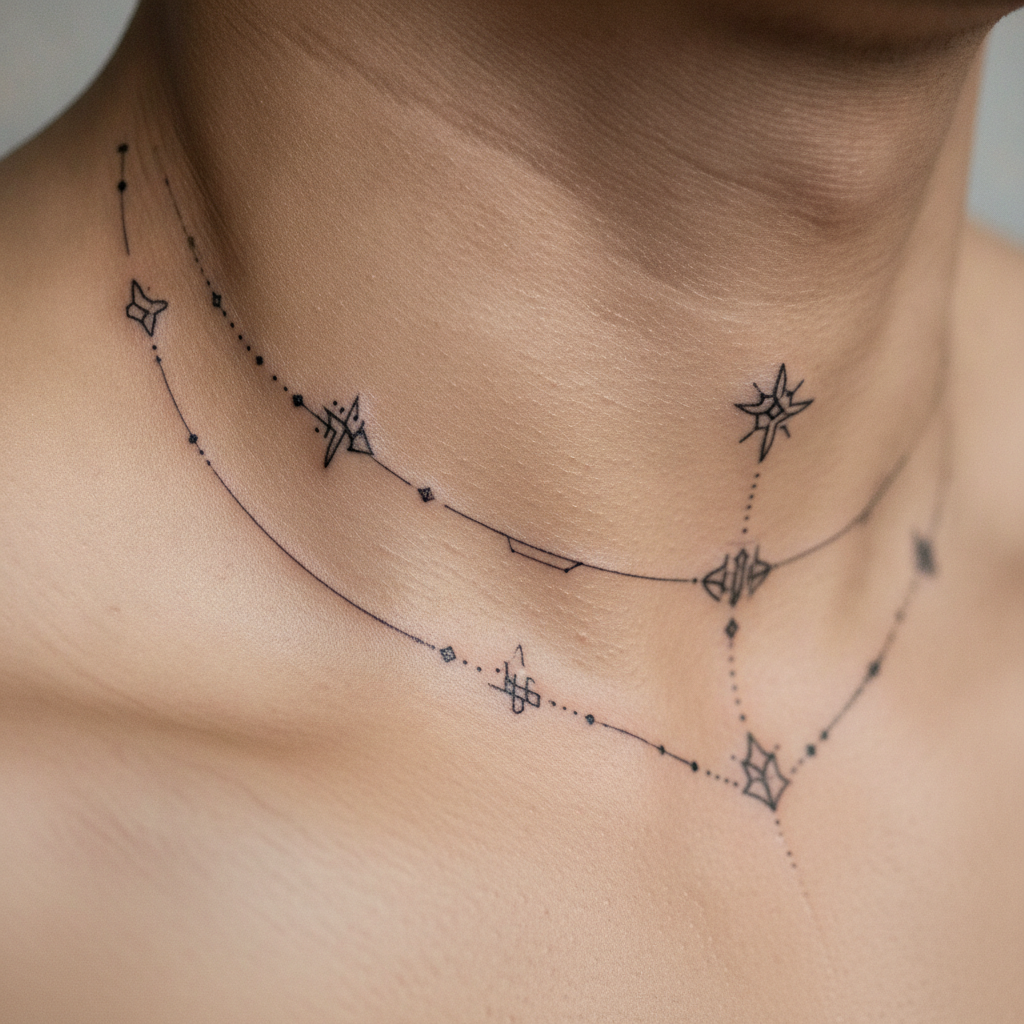
What makes it read as its own category is the combination of three things. Small symbolic marks that look like invented glyphs. Thin orbital or elliptical lines that seem to pull the symbols into motion. And clusters of stippling or dot trails that suggest speed, energy, or a scientific diagram. When any one of those is missing, the piece stops looking like sigilism and starts looking like generic fine-line ornamental work.
Visual rules of a strong sigilism piece
The line weight sits between 0.20 mm and 0.35 mm. Most artists use a single-needle round liner (1RL) or a tight three-round liner (3RL) for the main forms, then switch to stippling machines or hand-poke for the dot fields. Ink is almost always solid black. Grey wash appears occasionally as a soft shadow beneath a symbol cluster, but full colour breaks the aesthetic and rarely works.
Composition matters more here than in most styles. A sigilism piece should have one dominant symbol or cluster, a secondary orbit or arc that frames it, and a scatter of small marks that fill negative space without crowding it. Amateur pieces fail on the third element. They either leave the arm looking sparse or they cram in so many glyphs that the piece reads as a smudge from three feet away. Ask the artist to send a mock-up on skin, not just on paper, because the curvature of the forearm or collarbone changes how the orbital lines land.
- Line weight: 0.20 to 0.35 mm, single-needle or 3RL
- Ink: solid black only, occasional soft grey wash
- Composition: one hero cluster, one framing arc, scattered marks
- Density target: 40 to 60 percent negative space by area
- Session count: 1 session for a small piece up to 4 hours, 2 to 3 for a half sleeve
Placement that actually works
Sigilism reads best on flat or gently curved skin where the orbital lines can stay geometrically clean. The inner forearm is the most requested placement because the artist has a wide flat canvas and the wearer can see the piece without a mirror. The outer forearm works nearly as well and holds up slightly better against sun exposure. The collarbone and sternum work for smaller, more symmetrical arrangements, and the back of the calf gives room for larger multi-cluster compositions.
Placements to avoid are the fingers, the sides of the fingers, and the inner wrist. Fine sigilism lines blow out or fade within 18 months on any of those spots because the skin regenerates faster and the ink migrates. If you love the look and want a hand piece, ask the artist to use slightly thicker lines (0.35 to 0.40 mm) and expect a touch-up at the two-year mark. For placement decisions in general, the tattoo pain chart is a useful cross-reference because several sigilism-friendly spots (sternum, ribs, spine) sit at the top of the pain scale.
What sigilism costs in 2026
Pricing follows the same logic as other fine-line black-ink work, with a small premium for artists known specifically for the style. Shop minimums in North America and Western Europe sit at $150 to $250. Hourly rates from a competent fine-line artist run $180 to $350 per hour, and named sigilism specialists (waitlists of six months or more) charge $400 to $600 per hour. In Southeast Asia and Eastern Europe the same quality of work runs 40 to 60 percent less, which is why sigilism tattoo tourism to Bangkok, Berlin, and Lisbon has grown fast.
Typical piece prices land in these ranges:
- Small single-cluster piece, 2 to 3 inches: $250 to $500
- Forearm composition, 5 to 7 inches long: $500 to $1,200
- Half sleeve with 3 to 5 clusters: $1,500 to $3,500
- Full sleeve: $4,000 to $9,000, spread across 3 to 5 sessions
For a broader baseline on modern fine work, the fine-line tattoo cost breakdown covers hourly ranges by geography and how deposits scale with waitlist length.
How it ages, and how to make it age better
Fine-line black ink at 0.20 mm is the weakest part of this style. On protected skin (inner forearm, upper arm, sternum) a well-executed sigilism piece looks crisp for 5 to 7 years before the finest lines start to soften. On sun-exposed skin (outer forearm, calf, hand) that window shrinks to 3 to 4 years. The stippling and dot fields fade faster than the solid arcs, which is why professional-grade pieces almost always need a touch-up on the dots by year three.
Three habits extend the life of a sigilism piece meaningfully. Daily SPF 50 on any exposed area, applied year-round rather than only in summer. Moisturising twice a day for the first six months, because hydrated skin holds pigment more evenly. And avoiding aggressive exfoliants (retinol, glycolic acid, physical scrubs) directly over the tattoo. The tattoo sunscreen and long-term care guide has the specific product categories worth using and the ones that dry the skin out.
Frequently asked
Is cyber sigilism just fine-line with symbols? Not quite. Fine-line is a technique category defined by needle size and line weight. Cyber sigilism is a visual style defined by symbol clusters, orbital lines, and dotted trajectories that happen to be executed in fine-line technique. A fine-line floral piece uses the same needles but is not sigilism. Most sigilism is fine-line, but a growing subset uses medium-weight lines (0.35 to 0.40 mm) for durability on hands and fingers.
Do the symbols mean anything? Almost never in a formal occult sense. Some artists design personal sigils based on the wearer's intention (a common request is a sigil built from the letters of a goal or word), but most glyphs are invented for visual composition and carry no fixed meaning. If you want your piece to encode a specific intention, tell the artist during the consultation so they can build the composition around it rather than treating it as decoration.
How long does a sigilism session take? A small single-cluster piece takes 90 minutes to 3 hours including stencil placement. A forearm composition takes 4 to 6 hours in one session. Larger sleeves are broken into 2 to 4 sessions of 4 hours each, usually spaced 3 to 6 weeks apart to let the skin fully heal between passes.
Will it blow out on my skin? Blowouts happen when ink is deposited too deep into the dermis, which is more common on thin-skinned areas like the inner wrist, ankle, and back of the hand. Sigilism's fine lines are more forgiving than heavy blackwork in one sense (less ink volume) but less forgiving in another (a 0.2 mm blowout is more visible than a 2 mm blowout because the reference line is so thin). Choose an artist with a portfolio of healed sigilism pieces, not just fresh ones. The tattoo blowout guide covers the specific causes and how to spot one early.
Can I add colour later? Technically yes, but almost no sigilism artists recommend it. Adding a colour wash under existing fine black work usually darkens the black rather than adding a distinct hue, because black ink sits above colour in visual dominance. If you want colour, plan it into the original composition and use it in small accents (a single red orbital line, a splash of pale blue behind one cluster) rather than as a fill.
What should I bring to the appointment? Bring reference images of composition rather than of finished tattoos, because your artist will design a piece specific to you rather than copying someone else's. Bring water and a snack for anything over 2 hours. Wear clothing that exposes the area cleanly without needing to be removed mid-session. And eat a real meal in the hour before you arrive, because fine-line work is faster than blackwork but the concentration required from the artist means longer uninterrupted stretches on the machine.


