style guides
Dotwork Tattoos Style Guide: Technique, Healing, Cost
Dotwork tattoos build images entirely from stippled dots. Here is how the technique works, what it costs, and how it heals.

Dotwork is one of the few tattoo styles where the technique itself is the whole aesthetic. Artists build the entire image out of single needle dots, with no solid lines and no packed black fields. The look is unmistakable in person: from a distance the piece reads as smooth grey shading, and up close it dissolves into thousands of individual points. This guide covers how dotwork is actually made, what it costs, how it heals differently from solid black, and how to choose a piece that will still look sharp ten years from now.
What dotwork actually is
Dotwork is a stippling technique. Instead of pulling lines or packing solid black, the artist taps the needle into the skin one dot at a time, varying the density of dots to create the illusion of tone. Dense clusters read as dark grey or black. Spaced dots read as mid grey. Wide negative space between dots reads as light grey or skin. The technique borrows directly from pen and ink illustration, etching, and pointillist painting, which is why dotwork pieces often have a printmaking or engraving feel.
There are two broad schools. Pure dotwork uses dots for the entire piece, including any visible outlines, so even the edges of a mandala are made of dots rather than a continuous line. Hybrid dotwork combines fine line linework with dotwork shading, which speeds the work up significantly and is what most studios offer when they advertise dotwork. Both are legitimate. Pure dotwork takes longer and costs more, but holds its specific look the longest because there are no lines to blur with age.
Common dotwork subjects include sacred geometry, mandalas, ornamental and decorative patterns, religious iconography, anatomical illustrations, botanical pieces like ferns and dried flowers, and surreal or dreamlike imagery. The style does not suit pieces that need bold graphic impact at a distance, like American traditional or solid blackwork. If you want a heavy, high-contrast look, see our blackwork tattoos style guide instead.
How the technique works on skin
Most dotwork is done with a single needle or a tight three-round configuration, run at lower voltage than line work. Artists slow the machine down so each dot is deposited cleanly without the needle dragging across the skin. Some artists use rotary machines for their consistent dot deposition; others prefer coil machines for the tactile feedback. Hand-poked dotwork exists and is popular in the ornamental scene, where each dot is tapped in with a needle held in the hand rather than a machine. Hand-poked work takes longer per square inch but produces some of the most refined dotwork you will see.
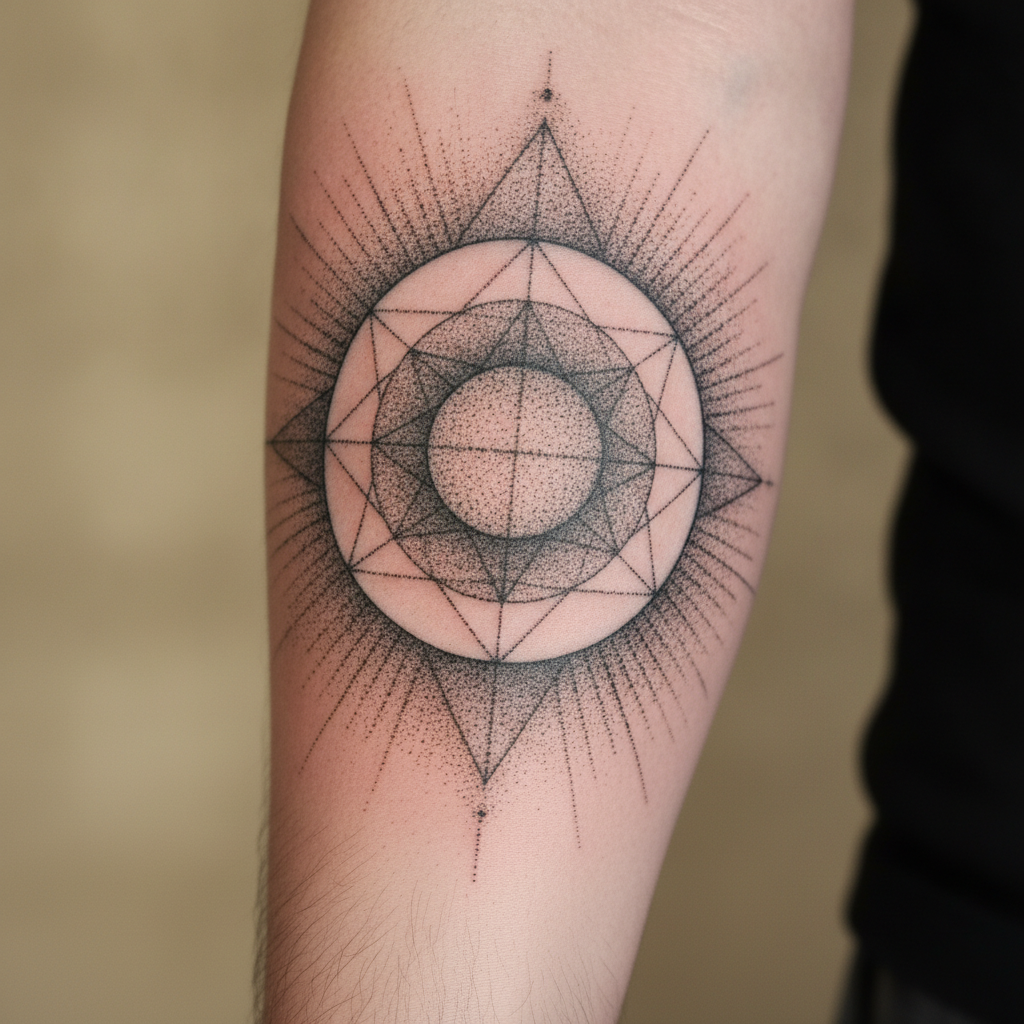
Session counts depend on size and density. A palm-sized geometric piece runs two to four hours in a single session. A full forearm mandala typically takes two to three sessions of three to four hours each. A back piece or full sleeve in dotwork can take ten to fifteen sessions spread over a year or longer, which is why dotwork is usually quoted by session and finished in stages rather than by total hour. The repetitive tapping is also why dotwork sessions tend to top out at four hours before the skin gets too irritated to take clean dots.
Cost and what to expect at the chair
Dotwork is priced like any other custom work, usually $150 to $300 per hour in mid-tier studios in North America and Western Europe, and $400 or more per hour for in-demand specialists. Specialist dotwork artists with strong portfolios in mandala or sacred geometry often charge a flat rate per piece rather than hourly, with palm-sized pieces in the $400 to $700 range and forearm pieces from $1,200 to $3,000. The flat rate reflects design time, since geometric and ornamental dotwork requires extensive stencil work before the needle ever touches skin. For a full breakdown of hourly versus flat-rate models, see hourly vs flat rate tattoo pricing.
Expect a deposit of $100 to $300 for any piece longer than a single session, applied to the final session. Geometric pieces in particular require a long stencil-fitting appointment, sometimes thirty to sixty minutes, because the artist needs to align the symmetry to your anatomy, not to a flat sheet of paper. A mandala that is symmetrical on paper will look crooked if it is not centered to the curve of your forearm or the slope of your shoulder. Good dotwork artists will redraw and reposition until the stencil sits correctly.
Pain during dotwork is different from line work. The slower, lighter taps are easier to tolerate moment to moment, but the cumulative buzz over a long shaded area gets uncomfortable in a different way, more like a constant scratch than the sharp drag of a liner. Heavily shaded fields can leave skin raw. Bony placements like the spine, ribs, and ankle still hurt more than fleshy areas like the outer thigh or upper arm.
- Palm sized geometric: $400 to $700, 2 to 4 hours
- Forearm mandala: $1,200 to $2,500, 2 to 3 sessions
- Half sleeve dotwork: $2,500 to $5,000, 3 to 6 sessions
- Full back piece: $6,000 to $15,000, 10 to 20 sessions
How dotwork heals and ages
Healing is where dotwork diverges most from other styles. Because the skin is punctured in thousands of discrete points rather than scraped along lines, the surface heals as a constellation of tiny scabs rather than a continuous scab. The fresh tattoo looks darker than it will permanently settle, sometimes alarmingly so, because the dots blur together while inflammation is still present. This usually resolves by day fourteen, when individual dots start to read as separate again.
Dotwork tattoos typically lose ten to twenty percent of their apparent darkness in the first month as the skin settles, which is normal and expected.
The peeling stage is gentler than line work because there is no continuous scab to pick at, but the trade-off is that fine dots in light grey areas can fall out if you over-moisturize or pick at the skin. A dot that does not heal in is gone, and the area will need a touch-up. Saniderm or second skin bandaging is widely used for dotwork because it keeps individual scabs from being disturbed by clothing. For day-by-day expectations, see our tattoo healing timeline.
Long-term, dotwork ages well in pure black ink. Because there are no fine lines to blur and no large solid blacks to fade unevenly, dotwork tends to soften gracefully over a decade. The piece will lose roughly thirty percent of its contrast over twenty years on most skin tones. Coloured dotwork is more vulnerable, since coloured ink in low density dots fades faster than the same colour packed solid. Most experienced dotwork artists discourage colour in dotwork for this reason and steer clients toward black only.
Who dotwork suits, and who it does not
Dotwork suits people who want a tattoo that rewards close inspection, who like geometric or ornamental aesthetics, and who are willing to sit through multiple long sessions. It also suits people on the lighter side of the skin tone spectrum where the high contrast between dots and skin is most visible. On deeper skin tones, dotwork still works, but artists will use denser dot patterns and skip the lightest shading values because the contrast is harder to read.
Dotwork is the wrong choice if you want a small, quick, single-session piece that reads strong from across a room. It is also the wrong choice for highly detailed portraiture or photorealism, where the eye expects smooth gradients that dotwork cannot match. If you are deciding between dotwork and another fine style for your first piece, our fine line tattoos style guide covers the closest alternative.
Choose your artist by portfolio specifically, not by overall reputation. A great realism artist is not automatically a great dotwork artist. Look for clean, consistent dot density, sharp geometric symmetry where applicable, and healed-piece photos taken at least three months after the session. Healed photos are what matter, since fresh dotwork can look stunning and still drop fine dots during healing.
Frequently asked
Is dotwork more painful than regular tattooing? Per minute, dotwork is usually slightly less painful than line work because the needle taps lightly rather than dragging. Over a long session, however, the cumulative irritation in shaded areas can feel rawer than line work. Most clients describe long dotwork sessions as easier to start and harder to finish.
How long does a dotwork tattoo take to heal? Surface healing finishes by day fourteen to twenty-one, similar to other styles. Full skin remodeling and final settling of the dots takes six to eight weeks. The piece will look darker than its final state for the first month, so do not panic if it seems heavier than what was inked.
Can dotwork be done in colour? Technically yes, but most artists discourage it. Coloured ink deposited in spaced dots fades much faster than colour packed solid, and the piece can look patchy within five years. Black dotwork holds its character far longer and is the standard for the style.
Does dotwork need more touch-ups than other styles? Fine grey areas with widely spaced dots are the most likely to need touch-ups, since individual dots can fall out during healing. Most reputable artists offer one free touch-up within the first three to six months specifically because of this. Solid black areas in dotwork rarely need touch-ups.
Will my dotwork piece blur like a fine line tattoo? Less so. Fine line tattoos blur because the thin continuous line spreads slightly under the skin over time. Dotwork does not have that problem since each dot is a closed point. What you will see instead is a gradual softening of contrast as ink particles migrate slightly, but the structural look stays intact.
Can I get a small dotwork piece as my first tattoo? Yes. A palm-sized geometric or ornamental dotwork piece on the forearm is a reasonable first tattoo. Avoid starting with a full mandala or anything requiring multiple sessions for a first piece, since dotwork stamina builds with experience. Sit a short piece first, then plan something larger once you know how your body handles it.