cost guides
Freehand Tattoo Cost: What You Pay for No-Stencil Work
Freehand tattoos skip the stencil and get drawn straight on your skin. Here is what that process costs, why it runs higher, and when it is worth paying for.
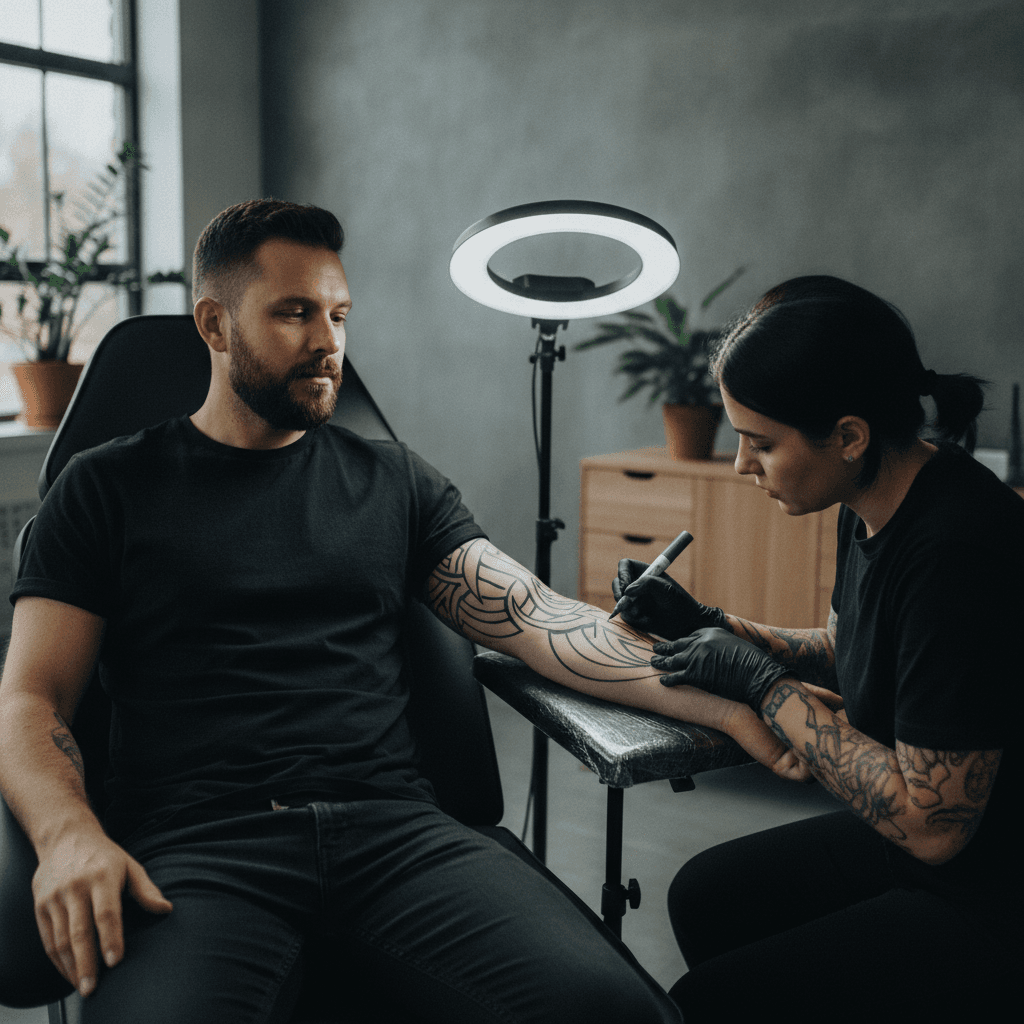
Freehand tattoo pricing sits at the upper end of custom work because the artist is drawing your design directly on skin with a surgical marker, no paper stencil, no transfer paper, no safety net. You are paying for an artist senior enough to draw a finished composition on a curved body part under studio light, in one sitting, with you watching. This guide covers hourly rates, flat quotes, where freehand actually makes sense, and the questions to ask before you book.
What freehand tattooing actually is
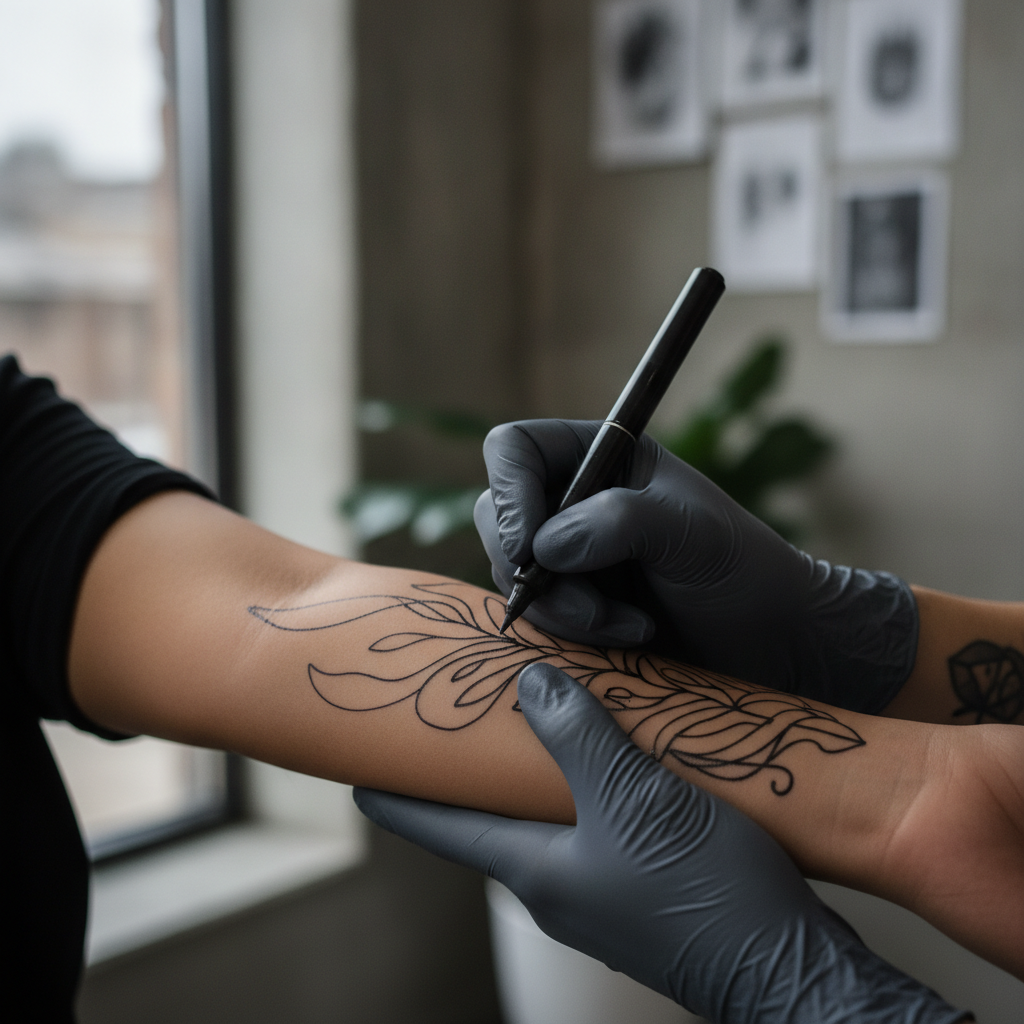
Freehand tattooing means the artist draws the design on your skin with a sterile surgical marker, then tattoos directly over those marker lines. There is no stencil machine, no thermal transfer, and often no finished drawing on paper beforehand. The artist works from reference images, a mood board, or just a conversation, then composes the piece live on your body. Some artists freehand the full composition, others draw a loose freehand skeleton and improvise the fills and shading as the tattoo progresses.
The method matters because stencils flatten a design onto a 2D paper plane before it hits your curved 3D anatomy. Freehand skips that step. The design follows the muscle, the bone, and the way your skin actually sits. On a bicep, a ribcage, or a shoulder cap, that difference shows up immediately. A stencil pulls flat across a curve and looks slightly off. A freehand drawing is already shaped to the body before the needle starts.
Hourly rates for freehand tattoos
Freehand work is almost always billed hourly, not flat rate, because the drawing time happens inside the session. Expect $200 to $400 per hour from an established freehand artist in a major US or European city. Specialists with waiting lists and strong portfolios in blackwork, ornamental, or Japanese irezumi regularly charge $400 to $600 per hour and sometimes more. In Southeast Asia and parts of Latin America, strong freehand artists can be found at $100 to $200 per hour, though the top tier in Bangkok, Mexico City, and Buenos Aires still command rates close to Western averages.
Session length is longer than a stenciled piece of the same size. The artist draws the layout, you both review it in the mirror, revisions happen with marker and alcohol, and only then does the machine come out. Budget 30 to 90 extra minutes on top of the pure tattoo time, especially for the first session of a multi-session piece. On an $300 hourly rate, that drawing time alone adds $150 to $450 to a session total.
What freehand costs by piece size
Rough all-in totals, assuming a mid-tier freehand artist at $250 to $350 per hour and realistic session counts:
- Small freehand ornament or flow piece, forearm or shin: 2 to 3 hours, $500 to $1,050
- Medium freehand piece, bicep or ribcage: 4 to 6 hours across one or two sessions, $1,000 to $2,100
- Freehand half sleeve: 12 to 20 hours across three to five sessions, $3,000 to $7,000
- Freehand full sleeve: 25 to 45 hours across six to ten sessions, $6,250 to $15,750
- Freehand back piece: 40 to 80 hours, $10,000 to $28,000 at the senior tier
Compare these to our breakdowns of full sleeve tattoo cost and back piece tattoo cost, and you will see freehand runs roughly 20 to 40 percent higher than the stenciled equivalent at the same artist tier. That premium is the drawing time, the artist seniority required, and the reality that most freehand specialists are already booked six to twelve months out.
Why freehand costs more than stenciled work
Three cost drivers push freehand above standard custom pricing. The first is artist experience. A junior artist cannot freely compose a sleeve on a bicep in one sitting. That skill takes a decade of consistent work. You are paying for that career curve, not just the session.
The second is time inside the booking. A stenciled custom piece typically arrives with the drawing already finished at home, scanned, resized, and printed. The chair time is just the tattoo. Freehand puts the composition inside the chair time, so the hourly meter runs while the artist draws, erases, redraws, and talks the layout through with you. On a six-hour session, 60 to 90 minutes can be pure marker work.
The third is revision risk. If a stencil comes out wrong, the artist prints a new one for $5 of transfer paper. If a freehand layout comes out wrong, the artist wipes it with alcohol and starts the drawing over, on your skin, on your clock. Senior artists get it right the first time, but the risk still prices in. A deposit of $200 to $500 is standard, and freehand artists more often require non-refundable deposits because they lose a full day of income on a cancellation.
Which styles actually suit freehand
Freehand pays off most on flow-driven styles that must wrap the body. Ornamental and mandala work benefits enormously because the geometry has to follow the limb curvature or the piece looks pasted on. Blackwork sleeves and chest pieces are often freehand-led, especially the negative-space compositions where the black fields define the body shape. Japanese irezumi background work (waves, wind bars, clouds) is almost always freehand even when the main subjects are stenciled.
Styles that generally do not suit freehand include fine-line micro work, portrait realism, and lettering. Fine-line micro depends on exact precision at a scale where even a 0.5mm marker line is too thick. Realism needs reference-locked proportions that only a stencil can carry. Lettering lives or dies by letter spacing and baseline accuracy, which freehand simply cannot match for serious script work. Any artist who insists on freehanding these styles is usually hiding a weakness, not showing a strength.
How to book a freehand session
Pick the artist by portfolio first, not by rate. A freehand portfolio shows the artist's work on curved body parts (biceps, ribs, backs) rather than flat canvas. Look for pieces that clearly flow with the muscle rather than sitting on top of it. Ask whether they freehand the full piece or draw a freehand skeleton and improvise the fills, because those are different workflows and different price points.
Book a paid consultation before the session. Freehand works best when the artist already knows your body, your reference images, your scar history, and the exact placement. A one-hour consultation at $100 to $200 is non-negotiable at the senior tier and saves you an entire wasted session if the artist decides your idea does not suit the method. Expect a deposit of $300 to $800 at booking and a session minimum of three to four hours, since freehand artists do not take short sits.
Frequently asked
Is freehand tattooing more painful? Not from the needle work itself. The pain comes from longer total session time, since the drawing adds 30 to 90 minutes inside the chair before the machine starts. A six-hour freehand sit on the ribs will feel longer than a four-hour stenciled version of the same piece.
Can I ask for revisions once the marker is on my skin? Yes, and most freehand artists expect it. Standing up, checking the layout in the mirror, and asking for adjustments is normal. The artist wipes with alcohol and redraws. Treat it like a dress fitting, not a done deal.
Do freehand tattoos heal differently? No. The healing process is identical because the ink goes into the same skin layer regardless of how the design arrived there. Follow the same tattoo healing timeline you would for any custom piece.
Will my artist let me see the drawing before they start? Always. Any freehand artist who starts tattooing without a mirror check and a verbal confirmation is cutting corners. You should see the full layout, agree to it on your feet, and then sit down for the tattoo.
Can beginners book freehand work? Technically yes, but it is rarely the right first move. A first tattoo is small, usually stenciled, and gives you a feel for pain, healing, and the artist. Save freehand for your second or third piece once you know what you tolerate in the chair.
Is freehand worth the price premium? On wrapped, flow-driven pieces that must follow the body, yes. On flat pieces, portraits, or lettering, no. Match the method to the design, not the other way around.