cost guides
Hourly vs Flat-Rate Tattoo Pricing: What to Expect
Hourly tattoo rates run $150 to $400+ per hour. Flat-rate quotes lock in a single number up front. Here's when each model favors you and how to spot a fair quote.

Walk into a tattoo shop with a design in mind and you will get one of two answers when you ask about price. The artist quotes a single number for the whole piece, or they quote an hourly rate and an estimate of how long it will take. Both are common, both are legitimate, and which one you get says a lot about the shop, the piece, and what you should be checking before you commit. This guide breaks down how each pricing model works, when each one favors the client versus the artist, and the real ranges you should expect in 2026.
How hourly pricing actually works
Hourly rates are the default for medium and large pieces, and for any tattoo with significant unknowns in the linework or rendering. Rates in the US currently run from around $150 per hour at solid mid-tier shops to $400+ per hour with name artists in major markets like New York, LA, and Austin. Apprentice work sits at $80 to $120 per hour. High-volume convention or shop minimums often start around $100 to $150 for anything under an hour.
What you are paying for in an hourly model is the artist's time at the chair, plus a small overhead for shop costs like chair rental, sterilization, and supplies. Most shops charge from setup to wrap, which means stencil application and bandage time often counts on the clock. Some artists pause the clock for long breaks, others do not. Always ask. A $250 per hour rate on a five-hour session with two ten-minute breaks lands at roughly $1,250, not $1,166. Those small accounting choices add up fast on multi-session pieces. See Tattoo Pricing Explained for a deeper breakdown of what drives those baseline numbers.
The honest case for hourly: nobody can accurately predict how long a complex realism portrait or a custom Japanese back piece will take. Skin reacts differently across body parts and across clients. Some sections render faster than others. Hourly aligns the artist's incentive with quality, because they are not racing a flat number to protect their margin.
How flat-rate pricing actually works
Flat-rate (sometimes called piece-rate or per-design) is a single agreed price quoted before the needle touches skin. This is standard for small to medium pieces with predictable scope: fine-line script, small symbols, geometric patterns, simple blackwork, and most shop flash. The artist looks at the design, the placement, and their own working speed, then quotes one number.
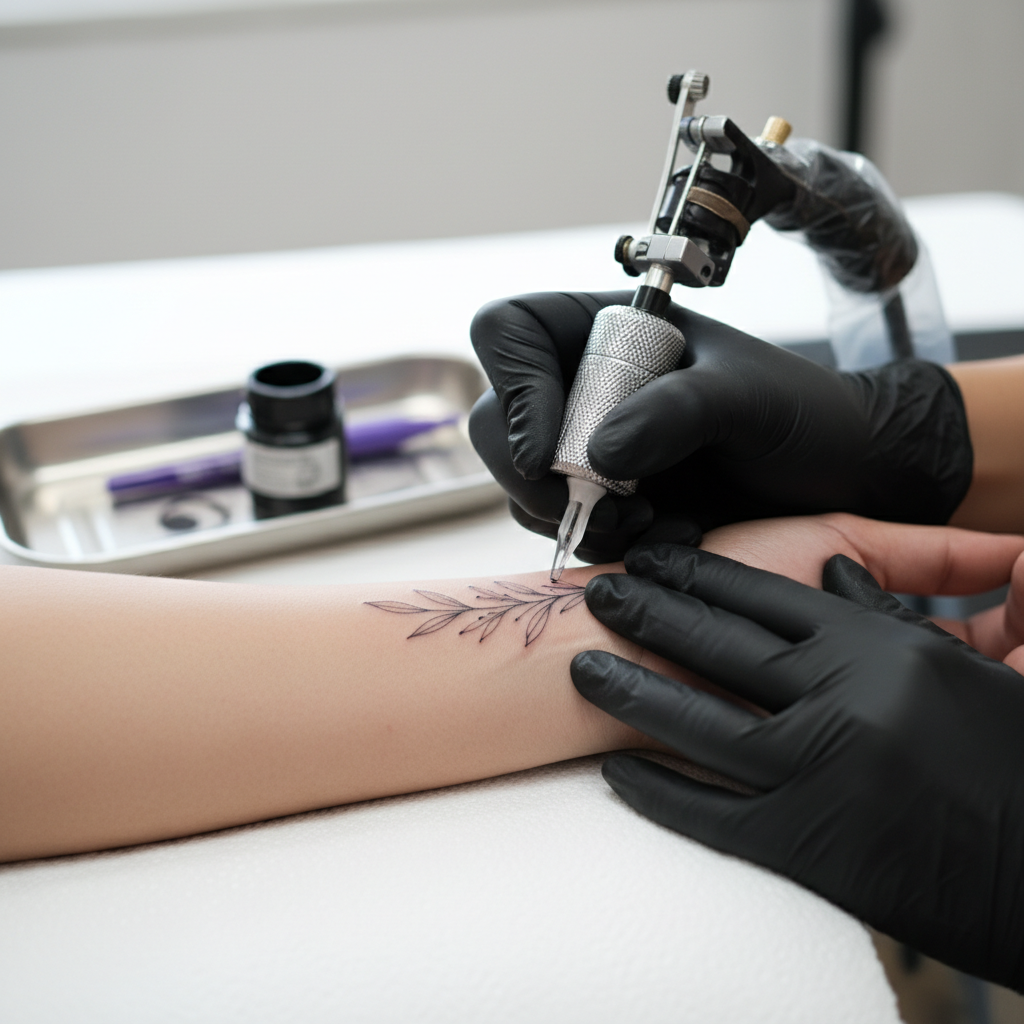
For a two-inch fine-line piece on a forearm at a $250 per hour artist, expect a flat quote of $200 to $350. The artist is essentially betting they can finish in 60 to 90 minutes. If they finish in 45, they earn more per hour than their nominal rate. If it takes two hours because of skin or placement quirks, they absorb that cost. Most artists pad their flat quotes to account for this risk, which means flat-rate is often slightly more expensive in pure math, but it removes uncertainty for the client.
Flat-rate is also the standard for sleeve and large-scale work that has been carefully planned across multiple sessions. Once an artist has done the consultation, sketched the layout, and mapped out session count, some will quote a project-total flat rate of, say, $4,500 for a half sleeve across three sessions. The math typically still backs out to their hourly rate, but the client gets predictability. For specifics on those big-piece numbers, How Much Does a Tattoo Sleeve Cost walks through the session math.
When each model favors you
Hourly favors the client when:
- The design is custom and complex, so a flat quote would be heavily padded to absorb risk
- The artist is fast and confident in the style, and you benefit from their efficiency
- You can split the piece across sessions and have flexibility to stop when budget runs out
- You trust the artist not to drag the clock
Flat-rate favors the client when:
- The design is small or stylized in a way the artist has done many times before
- You are budget-bound and need a hard cap to plan around
- The piece is simple enough that an experienced artist can quote it within 10% accuracy
- You are getting flash, which is by definition pre-priced
Mid-sized custom pieces of three to six hours sit in the gray zone where the model matters most. Ask both ways. Some artists will quote either format on request.
What to ask before you commit
Whichever model the artist uses, the questions you need answered are the same: what is included, what is not, and what happens if the piece needs a touch-up later. A clean quote covers stencil time, the actual tattoo, and a free touch-up window of typically 30 to 90 days. Things that often cost extra and should be confirmed upfront include redesign rounds beyond two revisions, rescheduling within 48 hours of an appointment, and color matching outside the original palette agreed at consultation.
Tipping is a separate line item in both models and is not built into the quote. Standard is 15 to 25% of the total price, paid in cash at the end of the session. How Much to Tip Your Tattoo Artist covers the edge cases for apprentices, multi-session pieces, and touch-up appointments where the math gets fuzzy.
Deposit handling also varies. Most shops take a non-refundable deposit of $100 to $300 that gets credited to the final price. If you cancel inside the rescheduling window, the deposit is forfeited. Confirm whether the deposit applies per session or only to the first one. On multi-session sleeve work, that distinction can mean the difference between $200 and $800 in sunk cost.
Red flags in either model
A few specific signals should slow you down. An hourly rate quoted without an honest hours estimate is a dodge. Good artists will say "this is a four to six hour piece" at minimum, even if the final time slides. A flat rate quoted without seeing the design or the placement is also a problem, because those two variables drive everything. A shop that refuses to put the quote in writing in a text or email confirmation before the appointment is a hard pass.
On the other side, prices that seem too low for the skill level on display in the artist's portfolio usually involve hidden costs: rushed sessions, inexperienced apprentices doing parts of the piece without disclosure, or aftercare products sold separately at marked-up prices. If a rate looks like half the local market, ask why. Once the piece is healing, you will want to know it was done at full speed and with full attention, not chopped up to pad the schedule. The first 24 hours set the tone for the next four weeks, which is why Tattoo Aftercare: The First 24 Hours reads like a logical companion to any pricing conversation.
Frequently asked
Is flat-rate always more expensive than hourly?
Not always, but usually slightly. Artists pad flat quotes to absorb the risk that a piece runs long. You pay a small premium for the certainty. On simple, predictable pieces the gap is small, often under 10%. On large custom work, flat quotes can sit 15 to 25% above the equivalent hourly math because the unknowns are larger.
Can I negotiate the hourly rate?
In most established shops, no. The rate is set, often shop-wide, and negotiating it suggests you do not understand the value of the work. You can sometimes negotiate scope (smaller piece, fewer colors) or scheduling (off-peak weekday rates at some shops), but the hourly number itself is fixed. Trying to haggle a name artist down from $400 to $300 is the fastest way to lose the booking.
What if a flat-rate piece takes longer than expected?
The artist absorbs the time. That is the entire point of flat-rate pricing for the client. Unless the design changes mid-session or you request additions, the agreed price stands. This is why artists pad flat quotes in the first place. If you keep asking for changes during the session, expect a polite conversation about adjusting the price.
Do all shops in the same city charge similar rates?
Within a market, yes within a tier. A mid-tier shop in Brooklyn might run $200 per hour while a high-end private studio across the river runs $400 per hour. The variance reflects portfolio strength, demand, and shop overhead. Comparing rates without comparing portfolios is the most common pricing mistake first-time clients make.
Should I ask which model an artist prefers?
Yes. Their answer tells you how they think about their work. An artist who only ever flat-quotes everything is either highly experienced and confident in scope estimation, or shy of complex pieces. An artist who only ever charges hourly is often working at the higher end of custom. Most strong mid-career artists do both depending on the piece, and they will explain their reasoning if you ask.
Does hourly include the consultation?
Most shops do free consultations of 15 to 30 minutes for small to medium pieces. Longer planning sessions for sleeves or back pieces sometimes carry a fee of $50 to $150 that gets credited toward the final tattoo if you book. Ask before scheduling, especially with name artists whose calendar time is itself a premium.


