style guides
Illustrative Tattoos: Style Guide, Techniques, Longevity
Illustrative tattoos borrow from book art, ink-wash, and etching. Here is how the style is built, what it costs, and how it ages.

Illustrative tattoos sit between fine-line minimalism and full-blown neo-traditional. The category covers any tattoo that reads like a drawing lifted from a sketchbook, an etching plate, or the margins of an old picture book. Artists lean on confident line weight, hand-drawn imperfection, and painterly shading instead of the flat black fills and rigid boundaries you see in American traditional. This guide walks through the sub-styles, how the work is built on skin, what it costs in 2026, and how it holds up a decade later.
What counts as illustrative
Illustrative is a parent category, not a single look. The common thread is that the tattoo carries the visual language of drawing: variable line weight, ink-wash gradients, cross-hatching, stippled shadows, and open negative space instead of solid backgrounds. Subject matter tends toward animals, plants, characters, mythology, and small scenes with narrative weight. If a tattoo could plausibly live on the page of a hardcover novel or a 19th-century natural history plate, it lands in this category.
Within illustrative you will hear four main sub-styles thrown around by artists. Storybook illustrative uses picture-book proportions, cute anthropomorphic characters, and warm color washes reminiscent of children's book illustration. Ink-wash illustrative mimics Chinese and Japanese sumi-e brush work, with soft grey gradients bleeding out from the main line work. Etching illustrative draws from Dürer and old engraving plates, built almost entirely from parallel hatch lines and stipple. Sketch illustrative keeps construction lines, arrows, and margin notes visible on purpose, so the finished tattoo looks like a page from a working artist's notebook.
The style overlaps with neo-traditional tattoos at the color end and with fine-line tattoos at the delicate end. What separates illustrative from both is the deliberate hand-drawn feel. A neo-traditional piece uses bold outlines and packed color. A fine-line piece leans on hairline single-needle work. Illustrative sits in the middle and keeps a looser, artist-signature quality.
How illustrative work is built on skin
Most illustrative artists use two or three needle configurations across a single session. The main outline goes down with a 3RL or 5RL round liner at 4 to 6 volts, giving the confident but slightly imperfect line the style depends on. Softer secondary lines come from a single-needle or 1RL setup for the hand-drawn feel around fur, feathers, or fabric folds. Shading uses either a small round shader (3RS or 5RS) for stipple and dot gradients, or a small mag (7M1) for smooth ink-wash gradients.
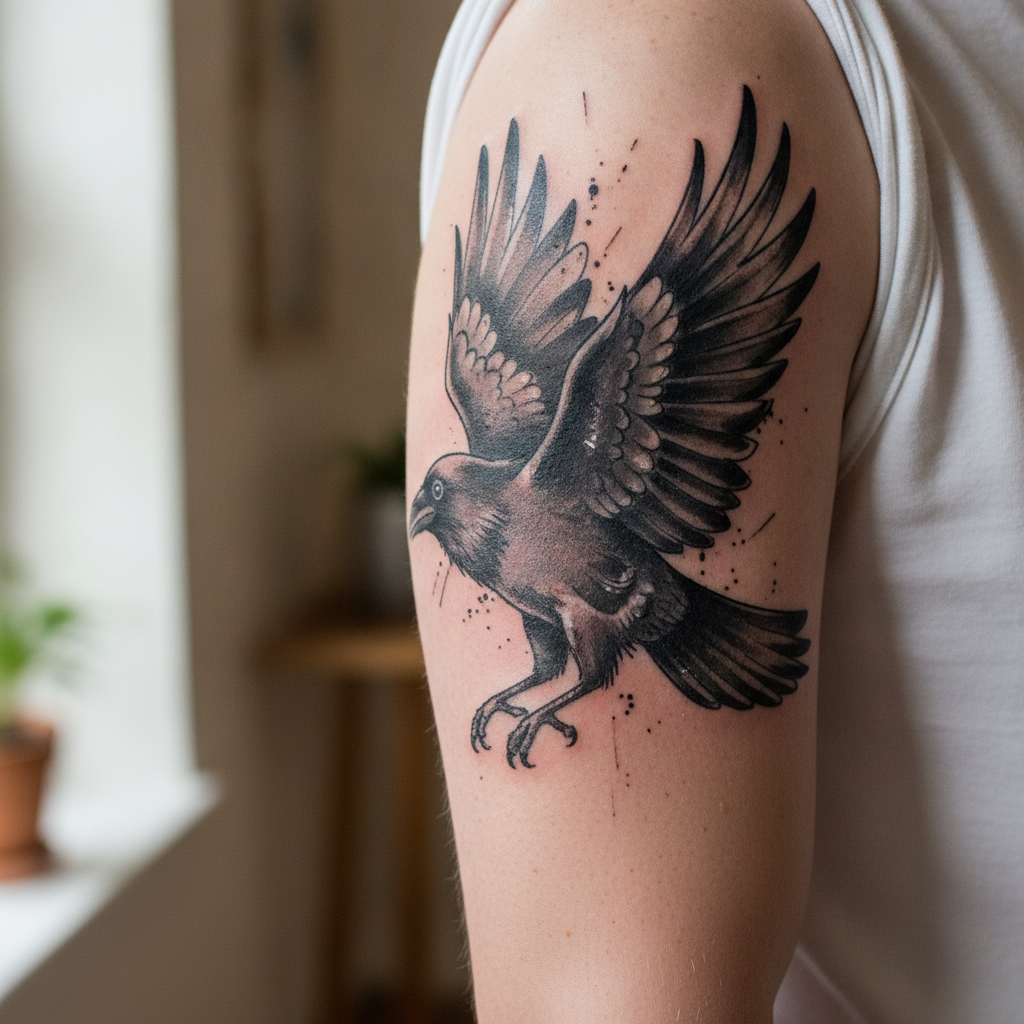
Ink brands matter less than machine setup and hand speed. Most artists working illustrative in 2026 run Eternal Ink, Fusion, or World Famous for color, and Dynamic Triple Black or Kuro Sumi for the base line. What defines the finished look is not the pigment but how loose the artist keeps the shading pass. A tight, mechanical shading pass turns illustrative into realism. A looser pass with visible stipple and open negative space keeps the drawing energy alive.
Session length runs longer than fine-line but shorter than realism. A palm-sized illustrative animal takes 3 to 5 hours in one sitting. A forearm piece with two subjects and background elements usually splits into two sessions of 4 to 6 hours each. Artists who work this style tend to book in half-day or full-day blocks rather than hourly, because the shading pass benefits from an uninterrupted rhythm.
What it costs in 2026
Illustrative pricing lands between fine-line and realism on the hourly scale. Expect $180 to $280 per hour with an established artist in a major US or European city, and $220 to $400 per hour with a booked-out name whose Instagram waitlist runs six to twelve months. In Southeast Asia and Latin America the same quality work runs $80 to $180 per hour.
- Palm-sized single subject: $500 to $900 flat
- Half-sleeve narrative piece: $1,800 to $3,500 across two sessions
- Full back panel with three subjects: $6,000 to $12,000 across four to six sessions
- Small ink-wash accent piece (3 by 3 inches): $300 to $600 flat
Custom illustrative work almost always beats flash pricing on this style because the whole appeal is the artist's personal drawing language. Flash sheets do exist, particularly for storybook and etching sub-styles, and those sit in the $250 to $500 range for a small piece. If you want the artist's signature feel you commission custom. If you want the style at a lower price point you take flash. For a broader breakdown of how style choice changes total cost, see the tattoo pricing explained guide.
How it ages on skin
Illustrative work holds up better than watercolor and worse than blackwork. The line work stays sharp for eight to twelve years before the first hairline lines start to soften. Ink-wash gradients bleed slightly over the same period, which some collectors actually prefer because it makes the piece look more like a real ink drawing. Etching hatch lines can blur into a solid grey block if the artist packed them too tight, which is why experienced illustrative artists leave 30 to 40 percent negative space inside every shaded area.
Skin tone changes what the style can do. On fair skin the full range of grey gradients reads cleanly, and delicate hatch work stays visible for over a decade. On medium skin tones the softer greys can wash out, so artists lean on stronger line work and higher-contrast stipple. On deeper skin tones illustrative still works but the ink-wash sub-style loses most of its subtlety. Etching and storybook translate better because they rely on line contrast rather than tonal gradient. A skilled artist adjusts pigment saturation and line weight up front instead of pretending skin tone does not matter.
Sun exposure is the single largest variable in how the piece ages. Illustrative tattoos with delicate line work and open shading fade noticeably faster than solid black pieces under the same UV load. Daily SPF 30 or higher on the tattoo adds five to eight years to how long the fine detail stays crisp. If you skip sunscreen for the first two summers after healing, expect a touch-up in year four instead of year ten. The tattoo sunscreen long-term care breakdown covers what to use and when.
Choosing an artist for illustrative work
Illustrative is a portfolio-driven style. Every artist's line quality, shading looseness, and subject preference is different, and the finished tattoo will look like their drawing hand no matter how detailed your reference is. Spend more time than you think you need reviewing their healed work on Instagram, not just fresh photos taken the day of the session. Fresh illustrative work looks stunning across the board because ink sits on top of the skin. Healed work at the six-month mark tells you whether the artist actually understands ink saturation.
Ask three questions before booking. What needle setup do you use for the shading pass on this style. How many sessions do you estimate for a piece this size. Do you have healed photos of similar work I can see. An artist who cannot answer the first two clearly is either new to the style or shortcuts the process. An artist who has no healed photos to share on the third question is either brand new or their work does not heal well, and both are reasons to look elsewhere.
Reference material should include drawings, etchings, and book illustrations you like, not other tattoos. Handing your artist a Pinterest board of other illustrative tattoos pushes them to copy someone else's hand. Handing them a folder of Arthur Rackham illustrations or Albrecht Dürer engravings lets them translate the source material through their own drawing language, which is the whole point of the style.
Frequently asked
How is illustrative different from neo-traditional? Neo-traditional uses bold, uniform outlines and packed color fills with clear boundaries between elements. Illustrative uses variable line weight, open negative space, and painterly shading that reads like drawing. Both categories overlap when illustrative work uses color, but the outline treatment gives the style away.
Does illustrative hold color well? Color illustrative uses lighter washes and delicate transitions, which fade faster than the saturated fills used in neo-traditional or American traditional. Expect to touch up color illustrative every five to seven years to keep the range readable. Black-only illustrative holds up much longer and rarely needs a touch-up before year ten.
Can illustrative work go on ribs or hands? Ribs work well for illustrative because the flat plane suits large narrative compositions. Hands are harder because the skin turns over faster and the fine hatch work blurs within two years. If you want illustrative on a hand or finger, ask the artist to simplify the line count and skip the delicate stipple work.
Is illustrative good for a first tattoo? Yes if you pick a small, single-subject design and an artist who has healed photos of similar work. It is not a good first tattoo if you want a full sleeve on the first sitting, because illustrative sleeves need multiple sessions of planning to keep the drawing energy consistent across the piece. Start with a palm-sized subject and see how you like the healed result before committing to a larger project.
How long does an illustrative sleeve take? Plan on 25 to 40 hours of tattoo time spread across four to eight sessions over six to twelve months. Complex narrative sleeves with multiple subjects and heavy background work stretch to 50 hours or more. Rushing an illustrative sleeve into two long sessions is possible but the drawing quality suffers because your artist needs time to review healed sections before adding new elements.
What should I bring to the consultation? Bring reference images from the source material that inspires you (books, prints, engravings, drawings) rather than other tattoos, a rough placement idea with a photo of the body part, and any color palette preferences. Skip the printed Instagram screenshots of other artists' tattoos. Good illustrative artists want to translate your idea through their own hand, not replicate someone else's finished work.