style guides
Neo-Traditional Tattoos: Style Guide and Examples
Neo-traditional tattoos combine the bold outlines of American traditional with refined detail, jewel-tone color, and modern subject matter. Here's how the style holds up.

Neo-traditional sits between two of tattooing's most identifiable looks: American traditional and modern illustrative work. It keeps the thick black outlines and bright color saturation of the classic style, then layers in finer line variation, deeper shading, and subjects that would have looked out of place on a 1940s flash sheet. If you want something that reads as a tattoo from across the room and still rewards a closer look, neo-traditional has earned its current popularity.
What defines a neo-traditional tattoo
Neo-traditional came out of the late 1980s and 1990s as artists started pushing past the rigid grammar of American traditional. The bones are the same: bold black outlines, limited but saturated color palettes, and recognizable subject matter like roses, daggers, big cats, and skulls. What changed is the level of detail. Lines vary in weight, shading is heavier and more layered, and color palettes lean into jewel tones, soft pastels, and unexpected accents like teal, burnt orange, or muted lavender. The result reads bolder than illustrative work and richer than the flat fills of true American traditional.
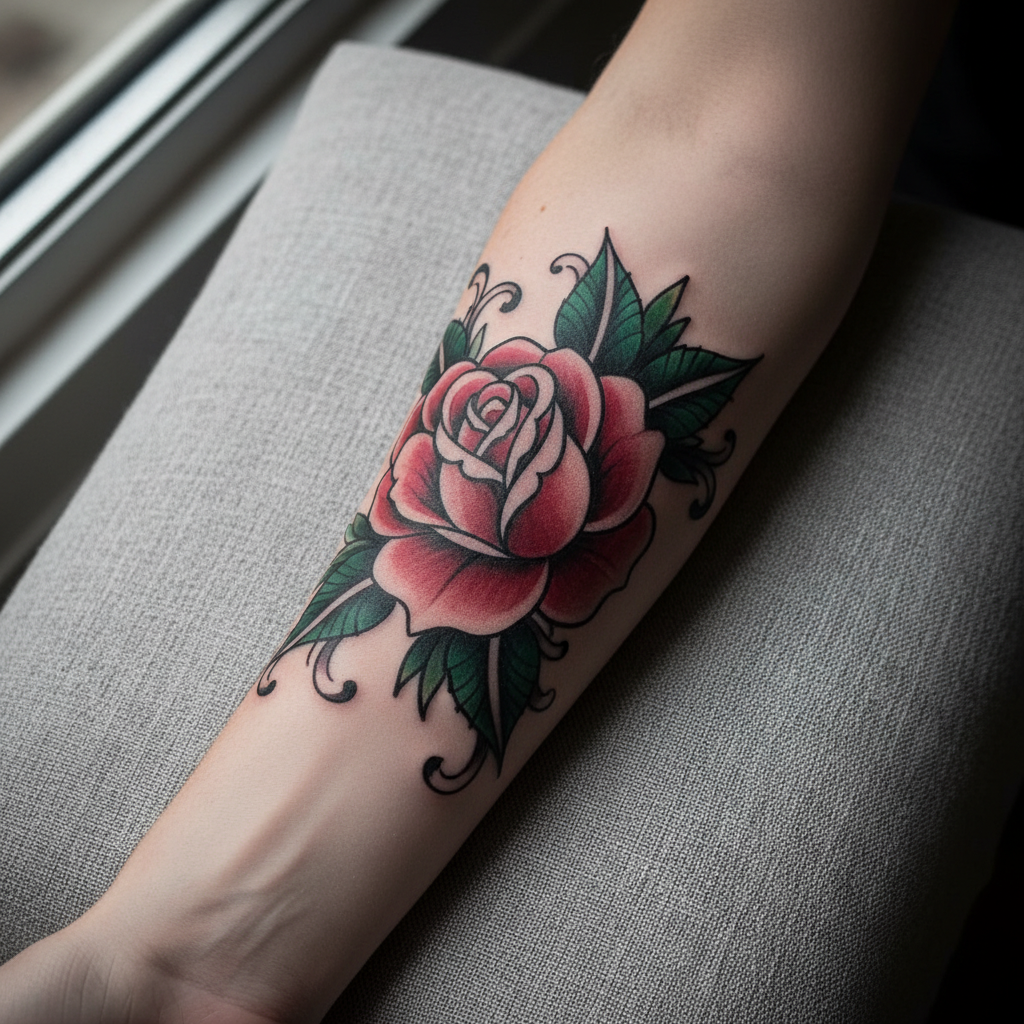
If you compare a classic American traditional rose to a neo-traditional one side by side, the differences are obvious. The traditional rose is built from a handful of bold shapes with flat color fills and minimal interior shading. The neo-traditional rose has dimensional petals, a richer interior gradient, ornamental leaves or filigree, and often a decorative background or frame. Line weight changes within a single petal to imply volume. Same subject, much more visual depth.
Common neo-traditional motifs include big-cat portraits, art-nouveau-inspired women, ornate keys, owls, wolves, classic sailor flash redrawn with modern detail, and floral pieces with botanical accuracy. Decorative frames, banners, and borders show up often as compositional anchors. Compared to blackwork tattoos, neo-traditional reads warmer and more figurative, with color doing structural work rather than acting as an accent.
Line weight, color, and shading techniques
Linework is the part most neo-traditional artists obsess over. Outlines are intentionally bold so the tattoo reads from a distance, but the line itself is not a single uniform weight. Skilled neo-traditional artists vary line thickness within the same piece. Heavier lines anchor the silhouette, lighter ones describe interior detail like petal veins, feather barbs, or fur direction. That variation is why neo-traditional pieces tend to look hand-drawn rather than stencil-flat.
Color work is layered and saturated rather than flat. Where American traditional uses pure pigment with hard color separation, neo-traditional artists pack pigment in layers and blend transitions with whip shading. A single petal might run from cadmium red at the tip into a deeper burgundy near the base, with a touch of pale pink for the highlight and a hairline of black for the shadow. Black and grey shading often goes in first as a structural undertone, then color saturates over the top. Sessions run longer because of this layered build, and most mid-size neo-traditional pieces take 3 to 6 hours of needle time.
How neo-traditional ages on skin
Bold outlines and saturated color are what give neo-traditional its long-term durability. Tattoos made with thin, fine lines soften noticeably after a decade as the body breaks down stray pigment particles and the skin loses elasticity. Neo-traditional outlines are wide enough to stay legible well after that softening starts. Saturated color fills age better than washed-out gradients because there is more pigment to lose before the design fades into mush. Expect a neo-traditional piece to still look recognizably itself at the 15 to 20 year mark, especially with daily sun protection.
Compared to fine-line work, neo-traditional needs less aggressive touch-up scheduling. A fine-line tattoo often benefits from a refresh every 5 to 8 years. A neo-traditional piece can usually go 10 to 15 years before any touch-up is needed, and that touch-up is typically limited to color punch-ups rather than full line rework. Skin tone affects how colors read over time. Light pastels and yellows soften faster than reds, blues, and greens, especially on tan or olive skin, so an experienced artist will weight the palette accordingly.
Healing is straightforward but heavier than a fine-line piece because of the saturated color. Expect more lymph and ink weep in the first 48 hours and longer scab phases through days 4 to 10. The full healing timeline applies here, with a slight push on the scab phase because of the deeper pigment load. Keep the tattoo out of direct sun for the first six weeks while the pigment settles into the dermis.
What neo-traditional costs
Neo-traditional sits in the middle of the price range for color work. Hourly rates from established neo-traditional specialists in the US typically run $200 to $350 per hour, with high-tier names charging $400 or more. A 4 by 5 inch forearm piece usually books in the $800 to $1,800 range, depending on detail density. Larger pieces like a half-sleeve land in the $2,500 to $5,500 range and need 3 to 5 sessions to complete.
A few things drive the price up:
- Higher detail density (ornamental backgrounds, multiple color transitions, filigree work)
- Larger color palette (every additional color adds mix and application time)
- Tighter placement (ribs, sternum, behind the ear, hand)
- Custom design fees, which range from $150 to $500 depending on revisions
- Deposit requirements, which usually run $100 to $300 and apply to the final session
For a deeper breakdown of how tattoo pricing actually works across styles and shops, see tattoo pricing explained.
Choosing your artist
Neo-traditional rewards artist specialization more than most styles. Bold linework, layered color, and ornamental composition are skills that take years to refine, and the gap between a generalist and a dedicated neo-traditional artist is visible at a glance. Look at healed work specifically, not just fresh photos. Saturated color looks great on day one. The real test is how the piece looks at the one-year mark, when swelling has fully resolved and the body has cleared loose pigment.
A few markers of a strong neo-traditional artist:
- Healed photos with crisp outlines and intact color saturation
- Consistent line weight variation across multiple pieces
- A coherent color palette across their portfolio, which signals intentional color theory
- Custom design work rather than recycled flash
- Willingness to do a paid consultation for a custom piece
Bring reference images of the subject, the color palette you like, and any compositional notes such as frames, banners, or background fills. Most neo-traditional artists prefer to redraw rather than copy, so reference is a starting point, not a spec.
Frequently asked
Is neo-traditional the same as new school? No. New school is a related but distinct style with cartoonish proportions, exaggerated perspective, and graffiti-influenced color use. Neo-traditional keeps subjects in realistic proportion and uses color for depth rather than visual effect. The two styles share saturated palettes and bold outlines, which is why people sometimes confuse them.
Does neo-traditional work on dark skin? Yes, with careful color choice. Saturated reds, greens, blues, and yellows show up well on deeper skin tones, especially over a strong black outline. Pastels and pale yellows tend to disappear on darker skin and should be swapped for adjacent jewel tones. An experienced artist will adjust the palette during the design phase, not at the needle.
How many sessions does a half-sleeve take? Most neo-traditional half-sleeves run 3 to 5 sessions of 3 to 4 hours each. The first session is usually line work and base color block-in, followed by color saturation, shading, and detail in later sessions. Sessions are spaced 2 to 4 weeks apart to allow proper healing between passes.
Will the colors look as bright as the fresh photo in 10 years? Slightly softer, not faded out. Saturated neo-traditional color holds its shape for a long time, but every color shifts a little after years of sun exposure and skin turnover. Reds and blues hold best. Yellows and pale colors soften first. Daily SPF on the tattoo cuts this aging in half.
Can I mix neo-traditional with black and grey work in the same piece? Yes, and many neo-traditional artists do this intentionally. A common approach is black and grey as the dominant tone with one or two color accents to draw the eye. This works especially well for portrait pieces or animal subjects where a fully colored treatment would feel busy.
Is neo-traditional a good choice for a first tattoo? For a first tattoo, the bold readability of neo-traditional is a real advantage. The downside is the higher pain load from saturated color packing and the longer healing window. A small to mid-size piece on a forearm or upper arm is a strong first tattoo. Save the ribcage and chest pieces for later, once you know how your skin handles long sessions.