design ideas
Patchwork Sleeve Tattoo Ideas and Layout Guide
A practical guide to patchwork sleeve tattoos: how to plan the layout, mix styles that still read as one arm, and avoid the common collector-style mistakes.
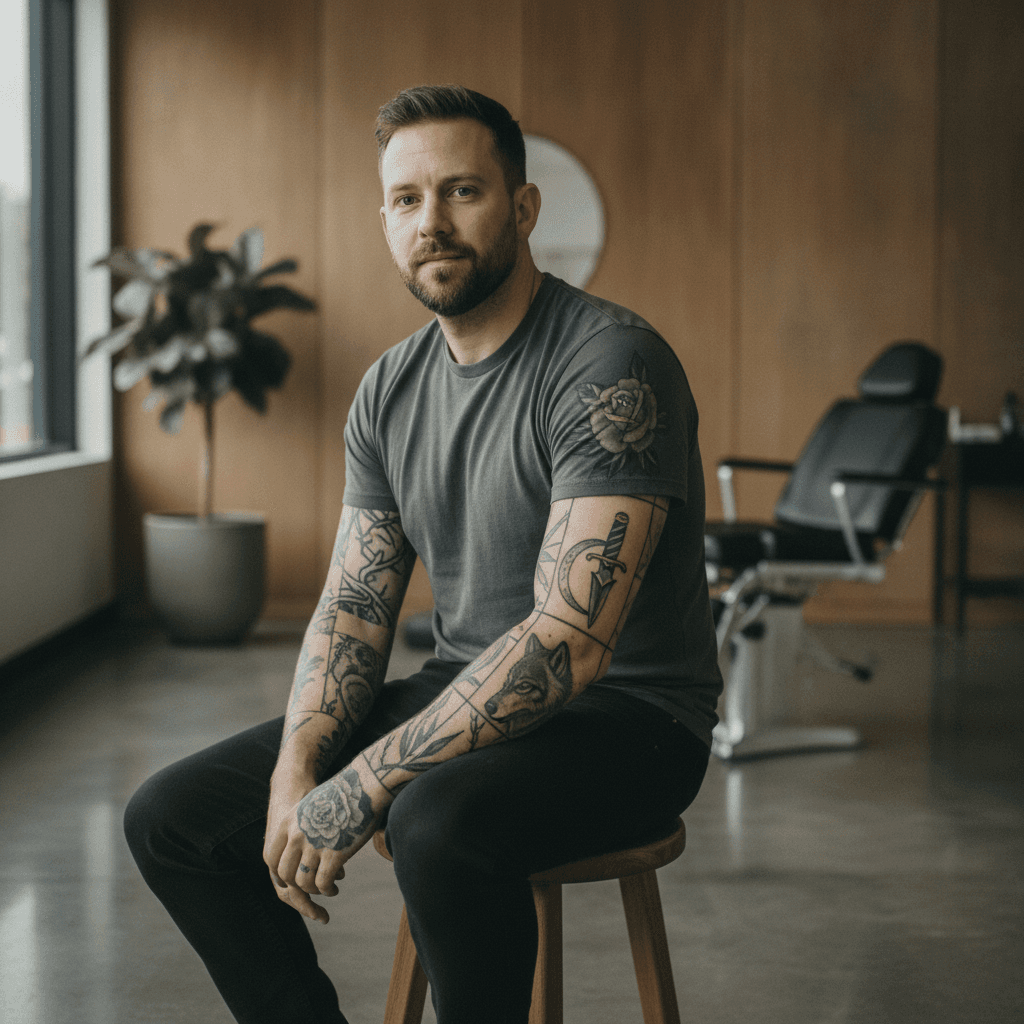
A patchwork sleeve is a full arm built from separate tattoos with visible skin between each piece. There is no shared background, no connecting smoke, no filler shading tying the designs together. Each tattoo stands on its own, and the arm reads as a curated collection instead of a single composed scene. This guide covers how to plan the layout, which styles mix well, how much skin to leave between pieces, and the mistakes that turn a patchwork sleeve into visual noise.
What makes a patchwork sleeve different from a traditional sleeve
A traditional sleeve, whether Japanese irezumi or American traditional, uses background elements to pull the whole arm into one image. Wind bars, water, clouds, dot shading, or a solid black fill wraps around the designs and makes the arm read top-to-bottom as a single piece. A patchwork sleeve rejects that approach. Each tattoo gets its own borders, its own breathing room, and the viewer's eye jumps from piece to piece instead of flowing.
The practical consequence is huge. You can build a patchwork sleeve across years, with different artists, at different budgets, without needing to commit to a single theme on day one. Traditional sleeves usually require a full design mocked up before the first session, because every piece has to fit the surrounding background. Patchwork sleeves grow organically. The tradeoff is that the overall arm needs intentional curation, or it drifts into looking like scattered flash chosen on different moods across different years.
Patchwork works especially well for people who want a flexible collector-style tattoo journey, where each piece commemorates something specific rather than contributing to a themed whole.
Planning the layout before the first piece
Before any ink, map the arm with a dermatograph pencil or printed stencils laid out together. The goal is to decide the anchor pieces: two or three medium-to-large tattoos that establish the visual weight of the sleeve. Common anchor spots are the outer upper arm, the forearm facing out, and the inner bicep. These anchors should be the first pieces placed, usually in the 4 to 6 inch range, because they dictate how much room the smaller fillers get around them.
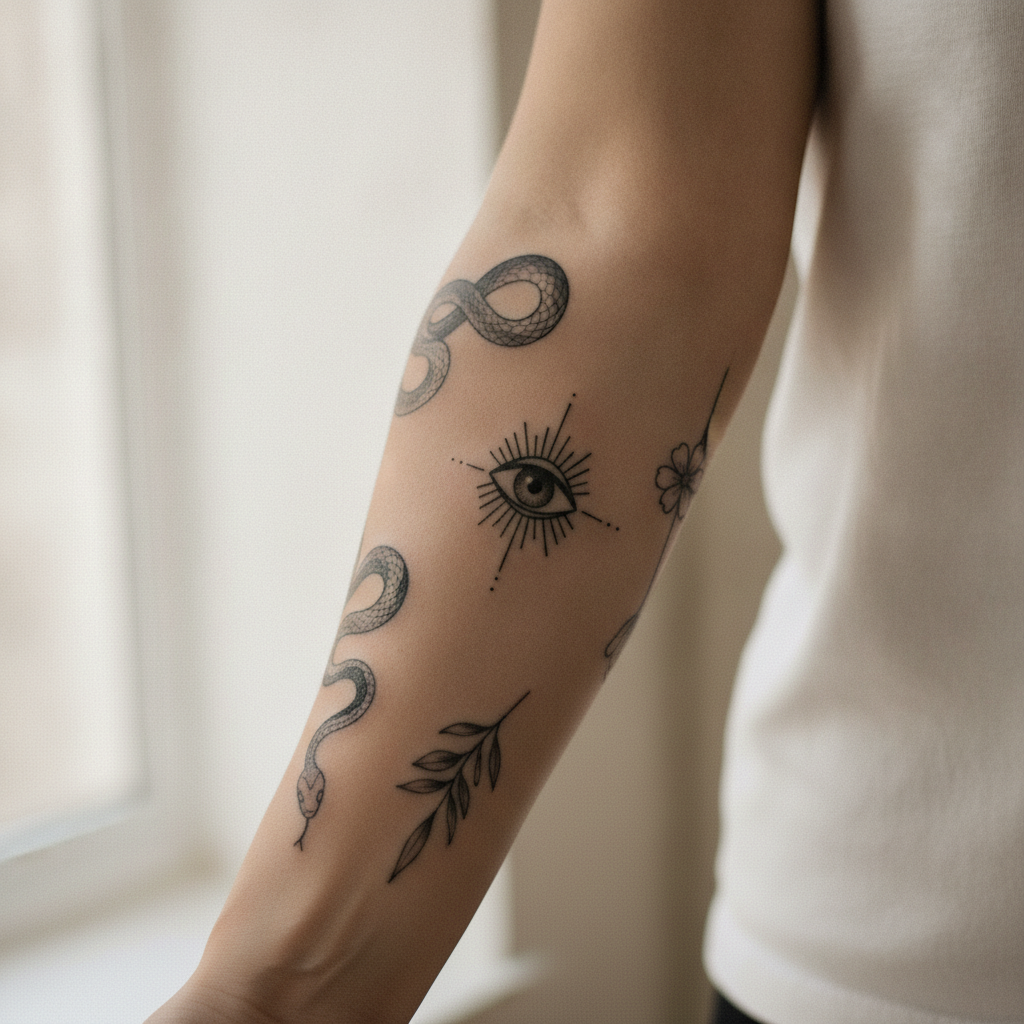
Spacing matters more than style choice. Leave at least half an inch of untouched skin between any two pieces, and leave a full inch between an anchor piece and its neighbors. Tattoos spread slightly over the first six months as the ink settles, and designs placed too close together will visually merge once healed. Patchwork loses its identity the moment the gaps close.
Think about placement by visibility too. The outer arm is seen by the world. The inner arm is seen mostly by you. Save sentimental or quieter pieces for the inner surfaces, and let the bolder, more graphic work live on the outer upper arm and outer forearm where it reads from across a room.
Style mixing that actually works
Patchwork gives you permission to mix styles, but not every combination holds together. Three style families tend to blend cleanly on one arm:
- Black-and-grey realism paired with fine-line botanicals and single-needle lettering
- American traditional paired with neo-traditional and bold illustrative blackwork
- Dotwork and geometric paired with ornamental and fine-line
The failure mode is mixing high-contrast bold work with delicate fine-line on the same arm with no transition. A heavy American traditional panther right next to a wispy single-needle fern will make the fern look like a mistake. If you want both aesthetics, separate them by at least six inches of other work or by moving one to the opposite side of the arm. The eye needs a buffer.
Color choices follow the same logic. Pick a palette and stick to it across the full sleeve. All black-and-grey is the safest patchwork path and the easiest to add to over years. If you want color, choose two or three accent colors you will reuse across pieces, so a splash of red on a rose later echoes the red on a dagger done two years earlier. Random colors across random pieces is what makes patchwork sleeves age poorly.
Session count, timing, and cost
A full patchwork sleeve typically takes 6 to 12 sessions over 12 to 36 months, depending on piece size and detail. Each session usually runs 3 to 5 hours, and most artists charge $150 to $300 per hour depending on experience and city. A patchwork sleeve from a mid-tier artist generally lands between $4,000 and $9,000 total. Fine-line specialists at the top of their field in Los Angeles, New York, or London can push the number past $12,000.
Sessions should sit at least 4 to 6 weeks apart to let each piece fully heal before working the surrounding skin. Working adjacent fresh tattoos on top of a still-healing piece raises the risk of blowouts and uneven settling. For the full healing arc of a single session, our tattoo healing timeline guide walks through what to expect across the first 30 days.
A sleeve of this type is a budget to plan quarterly, not a single invoice. Many collectors earmark one session every two or three months and let the arm fill in over three years.
Common patchwork mistakes to avoid
- Starting with filler-sized pieces. If your first three tattoos on the arm are each under 2 inches, there is no visual anchor and the sleeve never gains cohesion. Place anchors first.
- Chasing trends per piece. A chrome-style tattoo next to an American traditional rose next to a cyber-sigilism piece next to a hyperrealism portrait is four aesthetics fighting on one arm.
- Ignoring the inner bicep gap. Collectors fill the outer arm quickly and forget the inner surfaces. By year two, the inner bicep is the only untouched area and starts to look like a planning mistake.
- Over-tight spacing. Pieces touching or sitting within a quarter inch of each other read as one messy blob after healing.
- Mixing artists without curation. Different hands have different line weights. Pick two or three artists you trust and route specific style families to the one who does them best.
Frequently asked
Is a patchwork sleeve cheaper than a traditional sleeve? Usually similar in total cost, but spread over more sessions. A traditional sleeve may run 40 to 60 total hours in a compressed project arc, while a patchwork sleeve hits the same hour count distributed over three years. The hourly rate does not change, so the total converges.
Can I turn a patchwork sleeve into a traditional sleeve later? Yes, but it requires an artist willing to add connecting background work around existing pieces. Expect the integration to cost $2,000 to $4,000 on top of the original patchwork investment, and the result will look background-added rather than designed as one piece.
Should every piece be from the same artist? No. Patchwork actively supports multiple artists. Group them by style though: send black-and-grey realism to one artist, fine-line to another, and bold illustrative to a third. Random distribution across six different hands rarely holds together.
How much skin do I actually need to leave? Minimum half inch between neighbors, full inch around anchors, and leave 10 to 15 percent of the arm as permanent negative space. That negative space is what makes patchwork read as patchwork rather than a cluttered single sleeve.
Can patchwork work on darker skin tones? Yes, with style selection. Bold blackwork, American traditional, and heavy black-and-grey hold contrast beautifully on deeper skin. Fine-line and single-needle work can still read well if the artist is experienced with the skin tone, but needle depth and ink saturation matter more. See the dark skin aftercare guide for post-session specifics.
When do I know the sleeve is done? When adding another piece would require closing a negative space gap below the half-inch minimum. At that point the sleeve is visually full. Resist the urge to squeeze a final small piece in. The breathing room is the aesthetic.