style guides
Realism Tattoos Style Guide: Detail, Skin, and Aging
Realism tattoos look like photographs but age like watercolor. Here is how to plan, place, and price a realism piece that still holds up at year ten.

Realism is the style people request more than any other and the style most likely to disappoint them five years out. Done right, it reads like a photograph stitched into skin. Done wrong, it goes muddy fast and never recovers. This guide covers what realism actually is, how black-and-grey and color realism differ, how the work ages, what to expect on price and timeline, and how to find an artist who can pull it off.
What defines a realism tattoo
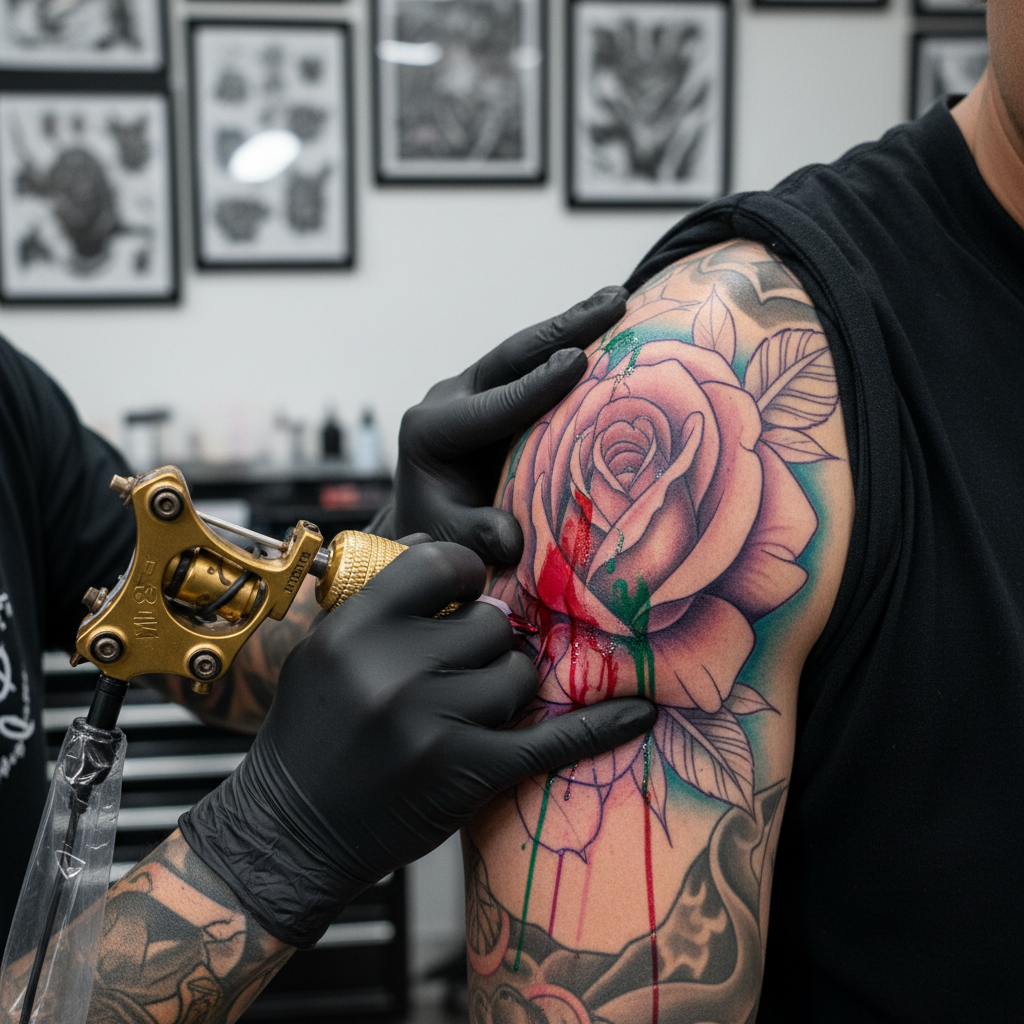
Realism is the imitation of a photographic image in ink. The artist works from a reference photo and translates it through pure tonal value rather than line. There are almost no outlines in a true realism piece, and any visible line means the artist used it as a planning crutch rather than a finished mark. Edges are built through gradients of black, grey, or color, and the illusion of depth comes from soft and hard transitions between those values.
Mag shaders and curved magnums are the workhorse needle groupings, usually in 7, 9, 11, 13, or 15 mag configurations, with single needles or 3-round liners reserved for the finest details around eyes and mouths. Artists work in low-voltage ranges, around 6 to 7.5 volts on modern rotaries, to keep skin trauma low across the long sessions realism requires. The whole technique is built around blending, which is also why realism is the slowest and most punishing style to do well. A clean realism piece can require three times the seat time of an equivalent traditional design.
Black-and-grey vs color realism
Black-and-grey realism uses diluted black ink to build a value scale from solid black down to almost-clear washes. Artists thin World Famous, Eternal, or Solid Ink black with distilled water or a proprietary wash mix to hit four or five distinct values, then layer them from light to dark across the session. It heals smoother because there is no pigment competition between colors, and it ages more predictably across decades.
Color realism layers separate hues to render skin tones, fabrics, leaves, and saturated objects. It is more visually arresting on day one and harder to maintain over the long haul. Color realism pieces typically need a touch-up by year 8 even from elite artists, because warm tones and reds shift fastest under sun exposure and yellows can fade by 30 to 50 percent within a decade. If you want a tattoo that looks like the reference photo at year 15, contrast-heavy black-and-grey beats color almost every time, in the same way pure blackwork holds even better as a graphic style.
How realism actually ages
Every tattoo softens over time as ink particles migrate slightly in the dermis. In realism this softening matters more than in any other style because the entire image is built from tonal precision. A 1 mm shift in a gradient that took the artist twenty minutes to lay can make an eye look glassy or a wrinkle disappear. The pieces that hold up best are designed with hold-up in mind: more contrast than the artist wants on day one, slightly bolder shadows in the deepest areas, and the smallest details restricted to focal points like eyes rather than scattered across the whole image.
Realism that holds at 10 years has more contrast than the artist wanted on day one. That extra contrast is the only thing standing between you and a faded ghost in your forties.
Skin tone changes how realism reads and ages. Darker skin tones reflect tonal range differently and require an artist who builds black mixes calibrated to Fitzpatrick IV to VI tones rather than working from a white-skin reference book. Sun exposure is the single biggest accelerator of fading, and daily sunscreen at SPF 30 or higher is the difference between a piece that holds at year 15 and one that needs a heavy touch-up by year 7.
Placement and size matter more than they look
Realism only works at certain sizes on certain parts of the body. A portrait under 4 inches will lose detail in the first three years no matter who tattooed it. The face simply needs room to breathe. Plan for at least 5 to 7 inches tall for a single portrait and 8 to 10 inches for a portrait with background elements like fabric, hair, or floral framing.
The best placements are flat-ish areas with stable skin: outer biceps, outer forearm, calves, thighs, upper back, and chest panels. Avoid hands, feet, fingers, and inner forearms for detailed realism. Skin on hands and feet sheds so fast that realism collapses within 18 months. The inner forearm has thin skin that holds detail well at first but stretches and creases more than the outer side, especially if you do any pulling or pressing in your daily life. Ribs and sternum tattoos can host realism but the pain levels make sessions short, which spreads a single piece across many bookings.
How to choose a realism artist
Realism reveals the artist faster than any other style. Look at healed photos rather than fresh ones, because healed work is what you are buying. Ask the artist directly for healed photos at the 3 month, 12 month, and 3 year mark of the same piece. If they cannot show that, the work is not yet proven and you are paying for hope. Watch the consistency of their portfolio. Ten amazing pieces and forty mediocre ones means you might get a mediocre one. Twenty consistent pieces means the artist has the skill locked in.
Pay attention to whether they specialize in your subject. A botanical realism artist will not necessarily nail a human portrait, and a portrait specialist will not necessarily nail an animal or a watch face. Booking with the right specialist matters more than booking the most famous name in your city. Quick checklist before you put down a deposit:
- Healed photos at 3+ months exist and look clean
- Their subject matter overlaps with what you want
- Portfolio looks consistent, not just a curated highlight reel
- They ask for high-resolution references and offer redraws before the session
- They quote in hours with a realistic session plan, not a vague flat rate
Cost and session expectations
Realism costs more per square inch than almost any other style because it is the slowest and most attention-intensive. A small black-and-grey portrait of 4 to 5 inches runs $400 to $900 across one or two sessions. A full forearm realism panel with multiple elements runs $1,800 to $4,500 across 3 to 5 sessions. A back piece or full sleeve runs $6,000 to $15,000 and takes 30 to 60 hours across 6 to 14 sessions. Pricing scales with hours, and realism artists almost never quote flat rate for anything bigger than a coin.
Hourly rates from established realism specialists in the US sit at $250 to $450 per hour as of 2026. European rates are similar in major cities like London, Berlin, and Madrid. Bali and Bangkok realism specialists run $120 to $250 per hour at the top end, with very strong work available at that price point. Expect a deposit of $200 to $500 to book and longer wait times than other styles. Top realism artists are booked 6 to 14 months out, and the best fully-booked artists open guest spots in major cities a few times a year, which is often the only way in.
Frequently asked
Does realism hurt more than other styles? Not directly, but realism sessions are much longer than most other tattoo styles. Pain accumulates over hours. A 5-hour realism session on the ribs will feel worse than a 2-hour traditional piece in the same spot. Schedule realism work in 3 to 4 hour sessions if you are pain-sensitive, and eat a real meal an hour before the appointment.
How many sessions will my realism tattoo take? Small pieces under 5 inches usually finish in one session. Medium pieces of 5 to 10 inches usually take 2 sessions with a 4 to 6 week heal between them. Larger pieces split into composition sessions plus a detail and finishing pass. Most artists book 4-hour blocks and stop when the skin starts to swell, because pushing tired skin trashes the heal.
Is color or black-and-grey better for a first realism tattoo? Black-and-grey, almost always. It heals smoother, ages more predictably, and forgives a slightly less experienced artist. Color realism takes years of needle-control practice to do well and decades of touch-ups to maintain. Start with black-and-grey, see how your skin handles a 3-hour session, then consider color for the next project.
Can dark skin handle realism? Yes, with the right artist. Look for portfolios that specifically show healed work on Fitzpatrick IV to VI skin. Black-and-grey realism on dark skin tones often looks cleaner than on pale skin because the contrast range is built around skin as a midtone rather than an overpaint base. Color realism on dark skin requires more experience and ink layering than most artists have honestly practiced.
How do I keep my realism tattoo looking sharp? Sunscreen at SPF 30 or higher on the piece any time it sees daylight, for life. Moisturize daily once healed. Plan a touch-up around year 5 to restore the deepest shadows. Avoid weight fluctuations greater than 30 pounds because skin stretches and detail breaks across the gradient. Stay out of tanning beds entirely, because they fade tattoos faster than direct sun.
What is the difference between realism and hyperrealism? Hyperrealism pushes the technique to invisible-pixel detail and often uses extreme contrast to read at distance. Standard realism aims for photographic likeness. Hyperrealism aims for surreal sharpness beyond what the camera even captures, with pores, eyelashes, and individual hairs rendered one by one. Hyperrealism is rarer, more expensive, and harder to age well because it relies on micro-detail that softens first.


