cost guides
Sternum Tattoo Cost: What to Expect to Pay in 2026
Sternum tattoo cost in 2026 runs $250 to $1,200 for most designs, with size, detail, and artist tier driving the final quote more than placement itself.

A sternum tattoo sits in the vertical channel between the breasts, running from just under the collarbones down toward the solar plexus. It is one of the most requested placements for ornamental, floral, and fine-line work, and it is also one of the more expensive per square inch. This guide breaks down what a sternum piece actually costs in 2026, why the numbers land where they do, and how to budget for a design that will still look sharp in ten years.
Typical price ranges by size and style
Most sternum tattoos in the United States and Western Europe fall between $250 and $1,200 for a single-session piece. A small fine-line ornamental design, roughly two to three inches tall and centered between the collarbones, usually runs $250 to $450 at a mid-tier studio. A medium ornamental or floral piece extending from the collarbone line down to the bra line, five to eight inches vertically, typically lands between $500 and $900. Larger sternum-to-underboob compositions that fan outward into rib coverage push into $900 to $1,800 territory and often need two sittings.
Style drives the number as much as size does. Fine-line and single-needle sternum work sits at the lower end of the hourly range because the linework is minimal, but the placement demands extreme precision so hourly rates stay in the $180 to $280 range. Ornamental blackwork with heavy stippling or mandala symmetry usually runs $200 to $320 per hour because the artist is essentially free-handing symmetry across a curved, moving surface. Realism and color sternum pieces are the priciest, often $250 to $400 per hour, and rarely finish in one session.
Hourly rates versus flat quotes
Sternum work is one of the placements where you should expect a flat quote for small to medium designs and an hourly rate for anything ambitious. A flat quote gives the artist room to work slowly on a difficult area without being rushed by the meter. If your artist offers a flat quote in the $400 to $700 range for a medium ornamental piece, that is usually fair and often better value than the same design billed hourly. For pricing context across placements, our tattoo pricing explainer breaks down how hourly, flat, and minimums stack up.
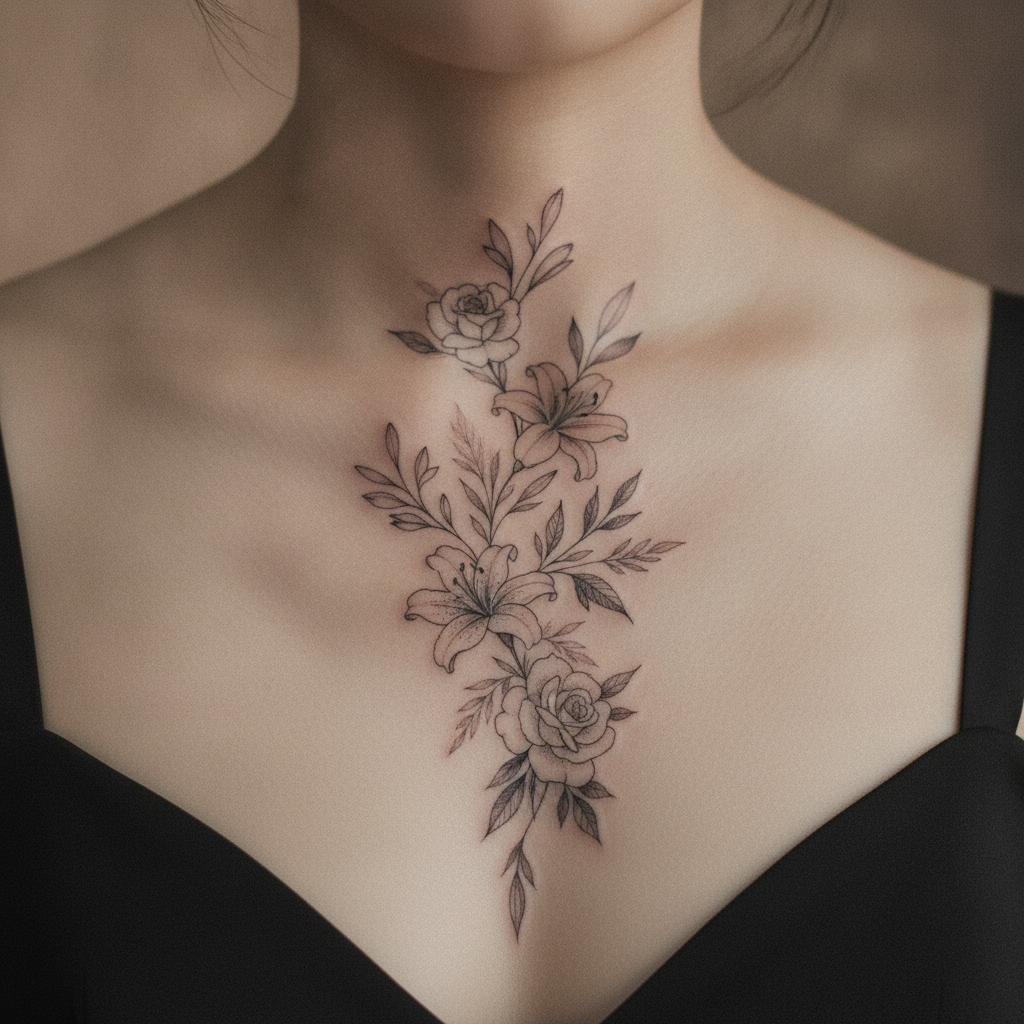
Larger multi-session sternum pieces are almost always hourly. Expect the first session to run three to five hours for the linework and initial shading, and a second session of two to four hours for detail, dot work, and finishing. Two-session totals for a full sternum-to-ribcage composition usually land between $1,400 and $2,800 at the mid-tier level, and $3,000 to $5,500 with a well-known artist in a major city.
Why the sternum costs more per square inch
The chest between the breasts is bony, thin-skinned, and moves with every breath. That combination makes precise linework harder and slower than the same design on a forearm or thigh. Artists price this in. Compared to a forearm piece of the same size, a sternum tattoo often costs 20 to 40 percent more because the artist works at maybe half the speed. There is also a stencil challenge. The sternum is symmetrical in theory but almost never in practice, and getting a mandala or floral design to sit centered on a curved bony ridge takes a longer stencil session, often 20 to 40 minutes before the needle even starts.
Session comfort is another cost driver. Sternum sessions are physically hard for the client. Many artists cap sessions at three to four hours here even if the client wants to push through, because tension in the chest and shoulders makes linework wobble. Shorter sessions mean more sessions, and every session carries setup time the artist has to price in.
Deposits, minimums, and hidden add-ons
Almost every studio charges a shop minimum, typically $100 to $200, which covers setup, needles, ink, and the artist's baseline time. For sternum work you will rarely hit the minimum because even the smallest ornamental piece takes 60 to 90 minutes. Deposits are standard and usually run $100 to $300, applied to the final total. If you cancel within 48 hours or no-show, expect to forfeit it. Our tattoo deposit guide walks through the standard etiquette here.
Common add-ons that catch first-timers off guard include:
- Custom design fees of $50 to $200 for artists who spend hours on a bespoke mandala or floral composition
- Touch-up appointments, usually free within 6 to 12 months but $80 to $200 after
- Numbing cream applied by the artist, sometimes $30 to $60 extra
- Tipping, which is standard in the US at 15 to 25 percent of the total
Tipping and total budget in practice
For a $600 mid-size sternum piece, budget $720 to $750 out the door with a 20 percent tip. For a $1,500 multi-session composition, tip on each session as you go rather than saving it all for the end. Artists appreciate this and it protects you from sticker shock at the final visit. If you are getting a large multi-session piece, some clients also bring cash for the tip specifically since it lands in the artist's pocket faster than a card tip.
Long-term budget planning matters more here than for most placements. Sternum tattoos are frequently touched up because the skin flexes constantly and fine lines can soften faster than on flatter areas. Plan for a $100 to $250 touch-up at the two to three year mark, and possibly another at the seven to ten year mark. Compared to a rib tattoo, the sternum holds up slightly better because the skin is less stretched by side-to-side movement, but sun exposure at the neckline still ages the ink faster than a covered placement would.
What drives your specific quote
Three variables move your quote up or down inside the ranges above. First, artist tier. A first-year apprentice charges $80 to $130 per hour, a mid-career artist in a major city charges $180 to $260, and a booked-months-out specialist charges $300 to $500 plus. Second, geography. Bangkok, Lisbon, and Berlin sit 30 to 50 percent below New York and London for equivalent quality. Third, design source. A pre-drawn flash sternum piece costs 20 to 40 percent less than a custom design because the artist has already amortized the drawing time.
Frequently asked
Is a sternum tattoo cheaper if I go smaller? Yes but not proportionally. A two-inch fine-line piece might cost $250 while a five-inch piece costs $600, because the shop minimum and the setup time do not scale with size. Going smaller saves money but you cross a floor around 60 to 90 minutes of chair time where the price stops dropping.
Do most sternum tattoos need multiple sessions? Small to medium designs finish in one session of two to four hours. Anything larger than roughly six inches vertically, especially with detailed shading or ornamental symmetry, usually splits into two sessions. Your artist will tell you honestly at consultation, and if they promise a huge piece in one sitting be skeptical.
How much should I tip on a $500 sternum tattoo? Standard is 15 to 25 percent, so $75 to $125. If your artist stayed late, adjusted the design on the fly, or worked through a tough session, tip at the top of that range. Cash tips are appreciated but not required.
Are sternum tattoos worth the extra cost compared to other chest placements? For ornamental, floral, and single-needle work, yes. The vertical symmetry of the sternum gives designs a natural frame that a chest-piece or clavicle placement cannot match. For bold traditional or larger illustrative work, a full chest piece often gives better value per square inch.
Can I finance a large sternum tattoo? Some studios in major cities offer buy-now-pay-later options through Affirm or Klarna for pieces over $500. Most independent artists do not. If you need to split payment, ask about doing the work across two or three sessions rather than financing, since that spreads the cost naturally without interest.
Does the sternum hurt more than other placements? Yes, most people rate it 8 or 9 out of 10, right up there with the ribs and spine. The bone is close to the surface and vibration transmits through the whole chest. Sessions feel longer than they are. Budget for shorter chair time and more sessions if you are pain-sensitive.


