aftercare
Vaseline on a New Tattoo: Why Most Artists Say Skip It
Vaseline on a new tattoo is one of the oldest aftercare habits and one of the most debated. Here's what petroleum jelly actually does to healing ink.

Ask ten tattoo artists about Vaseline and you will get eight no's, one shrug, and one who uses it as a wrapping lubricant during the session itself. The petroleum-jelly debate is older than most modern aftercare science, and it sticks around because the product is cheap, in every household, and feels intuitive on dry, tight skin. The problem is that a healing tattoo is not dry skin. It is an open wound layered with pigment, and what helps a chapped lip can quietly sabotage week one of your new piece.
What Vaseline actually does on broken skin
Petroleum jelly is an occlusive, which means it forms a physical seal on top of the skin. It does not moisturize. It traps whatever moisture, plasma, and bacteria are already underneath it. On a healthy intact surface that is sometimes useful, which is why dermatologists recommend it for cracked heels and post-laser skin where the barrier has been thinned but not opened. On a fresh tattoo, the top layer of skin has been deliberately broken thousands of times by needle penetration between 1.5 and 2 millimeters deep. That seal stops oxygen exchange and slows the formation of the thin scab layer your body is trying to build in the first 48 to 72 hours.
The other issue is heat. A thick petroleum layer raises the local skin temperature by a noticeable amount, which is why people often report their fresh tattoo feels hot and itchy after applying it. Heat plus trapped plasma is a textbook environment for bacterial growth. Most reputable shops moved away from recommending Vaseline somewhere between 2010 and 2015, and the ones that still mention it usually do so only for the first few hours before the bandage comes off.
The ink-pulling problem during the scab phase
Around days four to seven your tattoo will form a thin scab layer that looks slightly raised and dull. This layer contains a small amount of pigment that your body is pushing out, which is normal, but it is also pigment that you want to stay near the surface so the scab can flake off cleanly without leaving patches. Petroleum jelly softens that scab too aggressively and too unevenly. The result is the same thing artists call ink pull, where a chunk of the scab lifts before it is ready and takes color with it. You see it most on saturated blacks and deep reds, and it is one of the top three reasons people book a touch-up at the six-week mark.
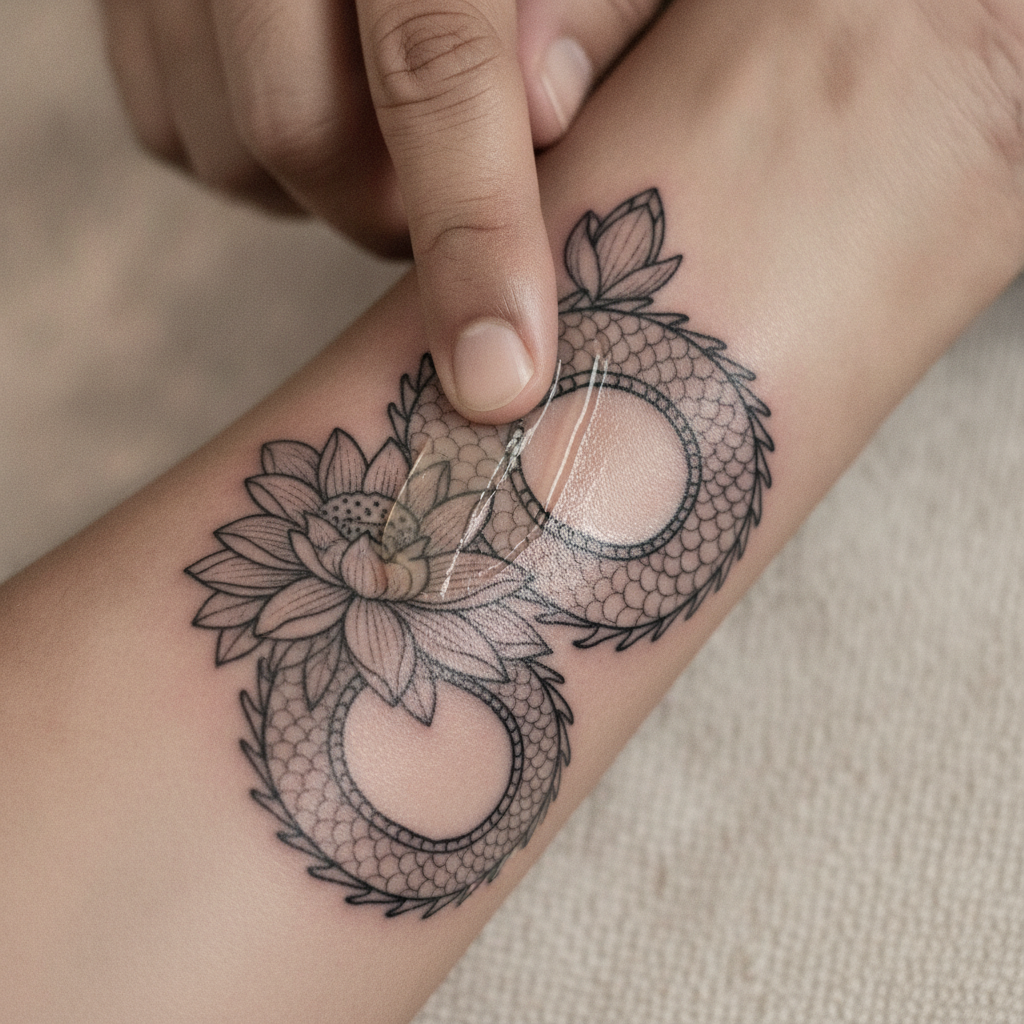
If you want a deeper read on what is normal versus a problem during this stage, our tattoo peeling guide walks through what flaking should look like day by day.
What artists recommend instead
The current consensus across most professional studios is a thin, fragrance-free, water-based or plant-oil-based balm. The exact brand matters less than the formula. You want something that lets the skin breathe, hydrates without sealing, and contains no lanolin, parabens, or heavy perfumes. Popular picks among artists run roughly $12 to $25 for a 30 to 50 gram tin, which is enough for a medium-sized piece through full surface healing.
- Aquaphor, used in a very thin layer for the first 24 to 48 hours only, then switched out
- Hustle Butter, a shea and coconut blend that stays popular for full-cycle healing
- Mad Rabbit Soothing Gel, a lighter water-based option for humid climates
- After Inked, a vitamin E forward lotion suited to color-heavy pieces
- Plain unscented cocoa butter or shea, for budget-conscious healing past day five
Apply a layer thin enough that you can still see the skin texture through it. If it looks shiny and thick, it is too much. Two to three applications per day is the standard, dropped to once daily once the scab has fully flaked. For a fuller breakdown of products and ranking criteria, our best lotion for a new tattoo post compares the top contenders side by side.
The two narrow windows where Vaseline is fine
There are two situations where Vaseline is not a bad call. The first is the wrap stage during the actual tattoo session, where some artists smear a thin layer over the skin before applying plastic film to keep the wrap from sticking to the wet stencil. That comes off within hours and never sees the healing phase. The second is once the tattoo is fully healed, around week six onward, where a tiny amount on a stubborn dry patch is harmless because the skin barrier has fully closed back up. Anything between those two windows, especially days one through fourteen, is where the petroleum-jelly approach causes the problems above.
It is also worth noting that climate changes the calculation. In dry, cold environments people lean more heavily on heavy occlusives because the air itself pulls moisture out of skin. Even there, a thicker plant-based balm performs better than petroleum jelly because it still allows some vapor exchange. Our humid climate aftercare guide covers the opposite end of the spectrum for anyone healing a piece in Southeast Asia or coastal summer weather.
How to recover if you have already been using it
If you put Vaseline on a fresh tattoo for the first day or two and the piece looks fine, do not panic. Wash the area gently with lukewarm water and a fragrance-free soap, pat it dry with a clean paper towel, and let it air for fifteen to twenty minutes before switching to a proper aftercare balm. Do not scrub. Do not pick at any scab that has already formed. If the tattoo is hot, swollen beyond a thin pink halo, oozing yellow fluid, or showing red streaks moving away from the piece, that is the threshold where you stop self-managing and contact your artist or a clinician. Our signs of tattoo infection guide details what crosses that line.
For everyone else the switch is straightforward. Treat days one through fourteen as the high-stakes window where product choice matters, then treat the rest of your tattoo's life as a sunscreen problem more than an ointment problem. Long-term color retention has more to do with daily SPF 30+ than it ever did with what was on the skin in week one.
Frequently asked
Is Vaseline bad for new tattoos in every case? Not every case, but in most cases yes. The risk is highest between days two and ten, when the scab is forming and the skin needs oxygen exchange. Outside that window the risk drops significantly, and for fully healed tattoos it becomes a non-issue.
Can I use Vaseline on the first night to sleep with my tattoo? This is one of the few defensible uses. A very thin layer the first night can keep bedsheets from sticking, especially if your wrap has come off. Apply it sparingly, switch to a proper balm by morning, and do not repeat it past 24 hours. Our sleeping with a new tattoo guide covers wrap strategy in more depth.
Will Vaseline fade my tattoo? Direct fading from petroleum jelly itself is unlikely. The fading risk comes from ink pull during the scab phase, not from the product leaching pigment chemically. The visible result is the same, patchy color, but the mechanism is mechanical, not chemical.
What about Aquaphor? Is that the same as Vaseline? Close but not identical. Aquaphor is petrolatum based but contains additional emollients and humectants like glycerin and panthenol. Many artists permit Aquaphor for the first 24 to 48 hours specifically because of those added ingredients, then ask clients to switch to a lighter formula. Pure Vaseline is plain petroleum jelly with none of those additions.
How thin should aftercare ointment actually be? Thin enough that you can run a finger over the area and not feel a slick residue after a few seconds. A pea-sized amount is usually enough for a piece the size of a deck of cards. If your tattoo is shiny and you can see your reflection in it, you have used roughly three times what you needed.
Does this advice change for color tattoos? The principle is the same but color pieces are slightly more sensitive in the scab phase, especially reds and yellows. Stick with a lighter balm and avoid any heavy occlusive for the full first two weeks. Our color tattoo aftercare guide goes deeper on pigment-specific differences.