cost guides
Anime Tattoo Cost: What to Budget in 2026
Anime tattoo cost breakdown for 2026: hourly rates, size brackets, color surcharges, and what to budget for full-color character pieces.

Anime tattoos have become one of the fastest-growing color categories in North America and Europe, and pricing has climbed with demand. A palm-sized character piece from a mid-tier artist runs $300 to $600 in most cities, and a full color sleeve dedicated to a single series can land between $3,500 and $9,000 across four to eight sessions. What makes anime pricing tricky is the color work: saturated reds, purples, and pastel skin tones all take longer to pack than black-and-grey shading, and licensed character likenesses push some artists into custom-quote territory.
What actually drives anime tattoo pricing
Three variables set the price for almost every anime piece: total ink area, color complexity, and the artist's booking tier. Ink area matters more than outline size because color packing takes two to three passes per section to hold vibrancy through healing. A 4-inch black-outline chibi character might take 90 minutes, while the same character in full color at the same size takes three to four hours. That difference translates directly into hourly billing at most studios.
Color complexity is the surcharge that surprises new clients. A piece using six or more colors requires more cap changes, more ink cost per session, and slower pace to avoid trauma when layering saturated tones over each other. Some artists build this into their hourly rate and quote you a flat number, while others itemize and charge a $50 to $150 color premium per session on top of hourly. Ask upfront which model your artist uses so the final invoice does not shock you.
Artist tier is the biggest single lever. A newer artist with a clean anime portfolio might charge $120 to $180 per hour. A mid-career artist with three to five years of specialization sits around $200 to $280. Guest artists and shop owners with waitlists over six months routinely charge $300 to $500 per hour, and a small group of internationally booked anime specialists command $600 or more with flat-rate quotes for large pieces.
Size brackets and real 2026 prices
Prices below reflect mid-tier artists in mid-sized US and European cities. Adjust up 30 to 50 percent for major metros like Los Angeles, New York, London, or Berlin.
- Micro anime piece (under 2 inches, minimal color): $150 to $300 flat
- Small character bust (3 to 4 inches, full color): $350 to $650
- Medium action pose or scene (5 to 7 inches, full color): $700 to $1,400
- Large half-sleeve piece with background: $1,800 to $3,500 across two to three sessions
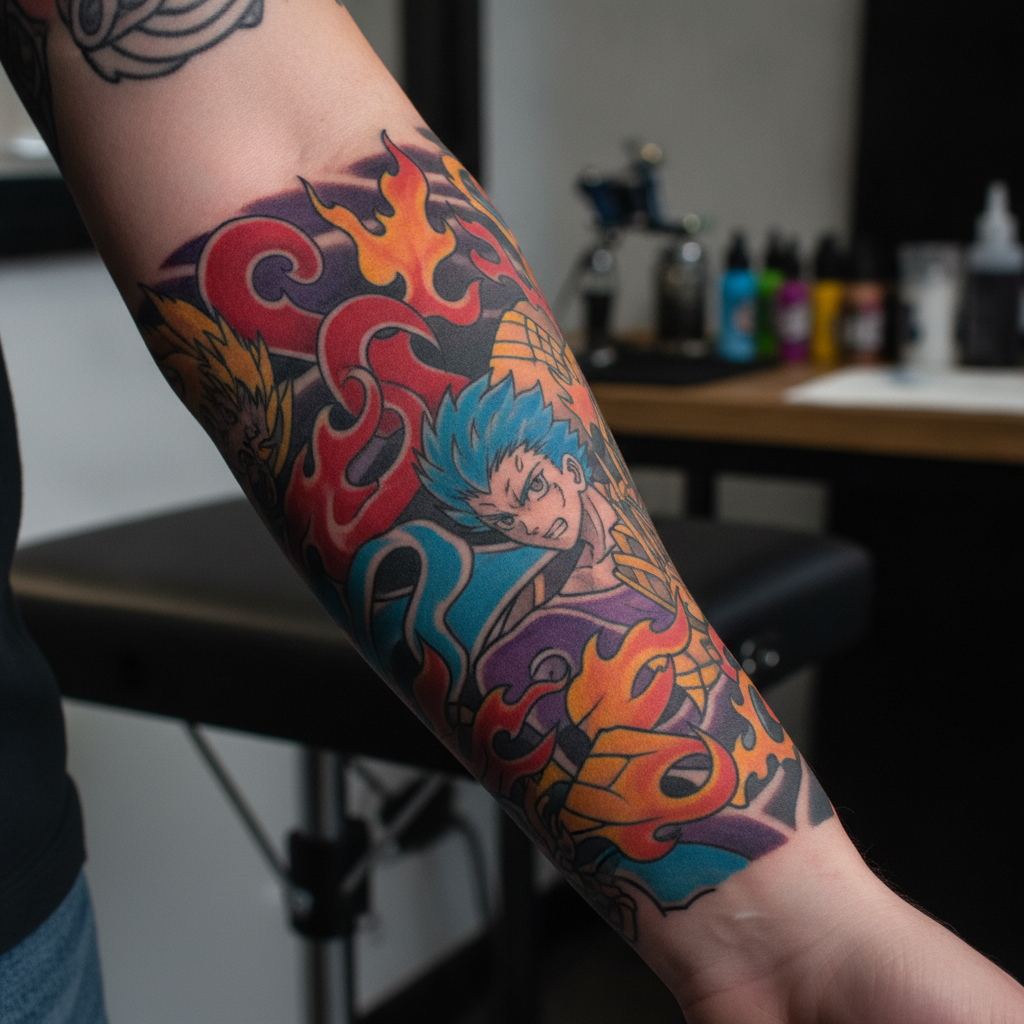
- Full color anime sleeve, single series: $3,500 to $9,000 across four to eight sessions
- Back piece with multiple characters and scene work: $5,000 to $14,000 across six to twelve sessions
Color surcharges you should expect
Anime work leans heavily on color, and color is where the hidden costs live. Expect a 15 to 25 percent premium over the same size piece done in black-and-grey. Skin tone rendering in the anime style often needs three to four ink shades blended smoothly, which is slower work than a solid fill. Hair with highlights and shadows can add an hour on a medium piece. If your reference calls for effects like glowing eyes, energy beams, or watercolor-style backgrounds, budget another 30 to 60 minutes of session time per effect.
Ink brand matters more than most first-timers realize. Studios stocking premium color lines like Eternal, World Famous, or Dynamic pay more per bottle and pass that cost through. A studio using cheaper student-tier inks may quote 10 to 20 percent lower, but the trade-off shows up in fade rates. Saturated anime colors on cheaper inks can lose 25 to 40 percent of their punch within three years, which means a touch-up cycle every two to three years instead of every five to seven.
Session count and how to plan the budget
Full-color anime pieces rarely finish in one sitting. Skin needs recovery time between color-packing sessions, and pushing through a full sleeve in one 8-hour session almost always produces uneven healing and patchy saturation. Most anime artists cap sessions at four to five hours and space them three to four weeks apart. For a half-sleeve budget three sessions, for a full sleeve budget five to seven, and for a back piece budget eight to twelve.
Deposits typically run $150 to $500 and lock in your first session. Some artists apply the deposit to the final session, others treat it as a design fee and it stays with the studio. Confirm the deposit policy in writing before you pay. If you cancel with less than 48 hours notice most studios keep the deposit outright. For a deeper look at how deposits work across styles, our tattoo deposit guide breaks down the standard shop policies.
Where anime work costs more (and why)
Certain design choices push anime tattoos into the top price bracket. Portrait-accurate character likenesses take longer than stylized reinterpretations because the artist has to nail specific facial proportions clients recognize instantly. Multi-character group shots require background composition work that a single-character piece skips entirely. Scene tattoos with architecture, weather effects, or motion blur can double session time compared to a plain-background portrait of the same size.
Placement changes the price too. Ribcage, sternum, and inner bicep anime pieces run 10 to 20 percent higher because the artist works slower on sensitive skin and stretches to stabilize the surface. Hands and fingers add a premium because ink retention there is poor and touch-ups within the first year are almost guaranteed. For a placement-by-placement breakdown of pain and pricing, see the tattoo pain chart.
How to save money without cutting corners
The cheapest legitimate way to reduce your anime tattoo cost is to simplify the color palette. A three-color piece with strategic black-and-grey shading can cost 30 to 40 percent less than the same design in eight colors, and often ages better. Ask your artist to propose a limited-palette version of your reference before you commit. Second, book weekday morning slots. Some studios offer 10 to 15 percent off Monday through Wednesday sessions to fill quieter hours.
Flash sheets are the other lever. Booking pre-drawn anime flash designs skips the custom design fee, which can run $100 to $400 for a full-color character piece. The trade-off is you share the design with anyone else who books it, but for a first anime tattoo the savings are real. To compare flash and custom pricing side by side, our custom vs flash tattoo cost guide breaks down the numbers.
What to bring to your consultation
Bring three to five reference images that show the specific character, pose, and color palette you want. Include one image showing the placement you have in mind so the artist can flag proportion or stretch issues. Bring measurements of the intended placement in inches, because most quotes tighten up once the artist sees actual dimensions. If you have a hard budget cap, say the number in the consultation. A good anime artist will scope the design to hit it rather than quote high and lose the booking.
Ask three questions in every consultation: what is the total hour estimate, what is the deposit policy, and how many sessions will this take. Get all three answers in writing before you pay. Any artist who refuses to give hour estimates in writing is signaling flexible billing that usually works against you.
Frequently asked
How much does a small anime tattoo cost? Small anime tattoos in the 2 to 4 inch range typically run $150 to $650 depending on color count and artist tier. A minimalist black-outline chibi from a newer artist sits at the low end, while a fully colored character bust from a mid-tier specialist lands closer to $500 to $650.
Are anime tattoos more expensive than black-and-grey? Yes. Full-color anime work runs 15 to 25 percent more per equivalent size because color packing takes longer, uses more ink, and requires slower layering. A 4-inch black-and-grey character at $350 becomes roughly $450 to $500 in full color at the same size and artist tier.
How many sessions does an anime sleeve take? A full-color anime sleeve typically takes four to eight sessions of four to five hours each, spaced three to four weeks apart. Total project time from first session to healed final piece usually spans six to nine months.
Do anime tattoos fade faster than other styles? Color anime work fades faster than black-and-grey because saturated pigments break down under UV exposure. Expect a touch-up every three to five years to maintain vibrancy, or every two to three years if the placement gets heavy sun exposure. Sunscreen use extends color life significantly.
Can I negotiate the price of an anime tattoo? Direct negotiation on hourly rate is uncommon and often insulting to established artists. What you can negotiate is scope: fewer colors, simpler background, smaller size, or moving to a weekday slot. A well-framed conversation about budget usually gets you a version of the piece that fits, not a discount on the original.
What is the cheapest way to get an anime tattoo done well? Book with a mid-tier artist who specializes in anime, choose flash over custom, keep the palette under four colors, and pick a placement outside the ribs, hands, and feet. This combination typically lands a quality medium-sized anime piece in the $400 to $700 range instead of the $900 to $1,400 top-of-market quote.