cost guides
Forearm Tattoo Cost in 2026: Pricing by Size, Style, and Session
Forearm tattoos run $200 to $2,500 in 2026. Here is what drives the price, hour-by-hour breakdowns by style, and the line items most shops do not advertise.

The forearm sits at the price sweet spot for most studios. Skin is flat, hold-still time is short, and the canvas is large enough for serious detail without forcing a full sleeve commitment. That makes it one of the most common first-tattoo placements and one of the easier ones to budget for accurately. This guide breaks down what a forearm tattoo actually costs in 2026, what drives the price up or down, and where the hidden line items tend to hide.
What a forearm tattoo costs at a glance
Most US shops price forearm work between $200 and $2,500. The wide range tracks four things: size, style complexity, color use, and the artist's seat rate. A small palm-size piece on the inner wrist runs $200 to $400. A half-forearm panel from elbow to mid-arm lands at $400 to $900. A full forearm wrap from wrist to elbow takes one long sitting or two shorter ones and runs $900 to $2,500 once you add color or heavy black packing.
- Small inner-wrist piece (under 3 inches): $200 to $400
- Quarter sleeve (wrist to mid-forearm): $400 to $900
- Half sleeve (wrist to elbow): $900 to $2,500
- Touch-ups: $80 to $200, often free in the first 60 days
These numbers assume a mid-tier US artist charging $150 to $250 per hour. Coastal cities like NYC, LA, and Miami trend 25 to 40 percent higher across the board. Smaller metros and college towns sit at the low end of every band above.
What actually moves the price
Five variables do most of the work: size, style, color use, artist tier, and geography. Size is the obvious one but it is rarely the dominant factor at the forearm scale, since most pieces fit in a single session of under 6 hours. Style matters more than square inches. A clean fine-line script piece can finish in 90 minutes, while a Japanese-inspired forearm panel with traditional shading takes 5 to 8 hours minimum and may need a second sitting.
Color tattoos cost more than black-and-grey at the same size and complexity. Color ink runs more expensive per cartridge, packing requires more passes for saturation, and the artist has to layer and rest sections to avoid skin trauma. Expect a 20 to 40 percent premium on a color piece versus the same composition in black-and-grey. For the full hourly-rate math behind these numbers, see tattoo pricing explained.
Artist tier compounds with everything else. A guest-spot artist with a six-month waitlist charges $300 to $500 per hour, even in mid-tier markets. A second-chair apprentice in the same shop may charge $80 to $120 per hour for the same square inches of skin, though their portfolio depth and consistency will be lower.
Hourly vs. flat-rate pricing for forearm work
Most forearm pieces fall in the awkward middle where artists can quote either way. A piece that runs 3 to 4 hours often gets a flat quote, which protects you from artist drift but caps the artist's upside if the work moves fast. Anything 5 hours or more usually goes hourly, since the artist needs to take real breaks and the time estimate gets fuzzier with each pass.
The hourly vs. flat-rate tattoo pricing breakdown covers the tradeoffs in depth. Quick rule: if the design is locked and the artist has tattooed similar work before, ask for a flat rate. If the design is custom and likely to evolve at the chair, go hourly and trust the artist's stopwatch.
How style shifts the bill
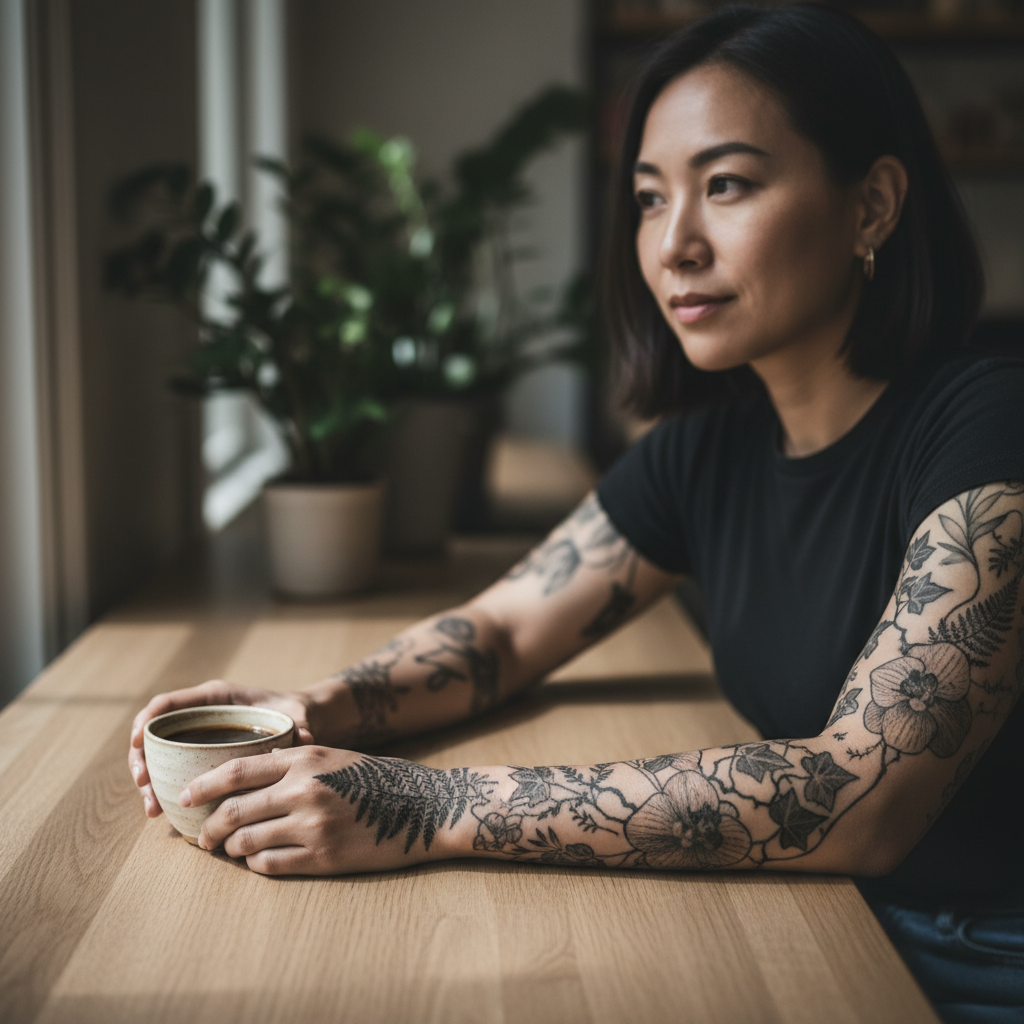
Fine-line and minimal pieces run $200 to $600 for a forearm. Single-needle and 3RL configurations work fast, but the artist needs steady technique and the piece needs scheduled touch-ups around year three as the lines soften. The fine-line tattoos style guide explains why these run cheaper to ink but more expensive to maintain across a decade.
Blackwork and bold-line traditional pieces run $500 to $1,200 on the forearm. The artist is packing solid black with 9- or 11-mag groupings, which is slow work that demands consistent saturation pass after pass. Time per square inch is roughly double a fine-line equivalent, but the payoff is a piece that holds shape for decades with no touch-ups needed.
Realism and micro-realism on a forearm panel runs $1,200 to $3,000. Photo-real skulls, portraits, and animal eyes need 8 to 15 hours of seat time and tend to come from artists with $250 per hour floors. Color realism adds another 25 percent on top of that, since the artist is mixing custom skin tones and layering for shadow depth.
Japanese irezumi runs $1,500 to $4,000 for a forearm sleeve. The style demands negative space, wind bars, and background flow, which means the artist usually quotes for the whole panel even if you start with a single dragon or koi. Long-term value is high since the composition stays coherent as you expand into a full sleeve over the years.
Hidden line items most people miss
Deposits run $100 to $300 and are non-refundable at almost every shop. They lock in your date and pay for the artist's design time before you sit down. Most shops apply the deposit to your final session, but confirm before you book or you may eat the cost twice. One round of design revisions is usually free; full redesigns trigger a new deposit.
Tipping is expected on top of the quoted price. Standard is 20 percent of the total session price for a regular artist, and 15 percent for a celebrity-tier artist whose hourly is already inflated. On a $600 forearm piece, that is $120 in cash on top of the bill, and cash beats card every time on the tip line so the artist keeps the full amount.
Touch-ups in the first 60 days are usually free if you followed the artist's healing protocol, which is one more reason to read the tattoo aftercare first 24 hours guide before you walk out of the studio. After that 60-day window expect to pay shop minimum, typically $80 to $150. Long-term, plan a paid touch-up every 5 to 8 years for fine-line and color work, and every 10 to 15 years for blackwork.
The forearm is the highest-tipping placement in many studios. Clients see the work every day, which makes them more generous when it heals well.
Frequently asked
Can I get a quote without consulting first? For small pieces under 3 inches, most shops give a phone or DM quote based on a reference image. For anything larger or custom, you need an in-person or video consult so the artist can see your forearm shape, skin tone, and existing ink. Consults are usually free but can run $50 to $100 at high-demand artists, applied to the final bill if you book.
Does color or black-and-grey cost more long-term? Color is more expensive over time. Color tattoos need touch-ups roughly every 5 to 7 years to keep saturation crisp, while black-and-grey at the same placement holds for 10 to 15 years before needing a refresh. Factor an additional $150 to $400 per refresh into your long-term budget if you commit to a color piece on the forearm.
How much does the inside of the forearm cost compared to the outside? Hourly rate is the same, but inner-forearm pieces often take 10 to 20 percent longer because the skin is thinner and the artist needs extra rest passes to avoid bruising. Pain is also higher on the inner forearm, which can shorten sessions and add a second booking fee. The tattoo pain chart maps the difference across the arm.
Is it cheaper to do a full sleeve in one booking versus piecing it together? Marginally cheaper, but the bigger win is design coherence. A full wrist-to-shoulder sleeve booked as a multi-session package often comes with a 5 to 10 percent discount versus paying session by session. See tattoo sleeve cost for the full multi-session breakdown and what the package usually covers.
What is the minimum I should expect to pay for any forearm tattoo? Shop minimum, which sits at $100 to $200 in most US studios and $150 to $250 in major coastal cities. That covers a tiny design that takes 15 to 30 minutes of seat time, including setup, stencil, and sterilization. Most shops will not go below their posted minimum regardless of how small the piece is, since the fixed cost of opening a station does not scale down.
Should I bring my own design or pay the artist to draw one? Either approach works. Bringing a polished reference saves design time and can shave $50 to $200 off the bill. Hiring the artist to design from scratch costs $75 to $300 in design fees but produces a piece tailored to your forearm's specific shape, muscle tone, and skin undertone. Custom work tends to age better because the artist accounts for how the lines will read as your skin shifts over the decades.


