design ideas
Ocean Tattoo Ideas: Waves, Marine Life, and Nautical Design
Ocean tattoos cover waves, sea creatures, and nautical motifs. Here is how to pick a subject, style, and placement that holds up long term.

Ocean tattoos pull from one of the oldest visual libraries in body art, going back to Polynesian wave patterns, Japanese irezumi dragons rising from surf, and old-school sailor flash from the 1920s. The subject matter is wide. Waves, koi, sharks, octopuses, anchors, compasses, lighthouses, mermaids, ships, coral, jellyfish, and shells all live under the same umbrella. That range means the planning stage matters more than it does for a single-subject piece. A fine-line seahorse on the ankle and a full Japanese back piece of waves and a hannya mask are both ocean tattoos, and they share almost nothing in terms of session count, pricing, or longevity.
Waves as a standalone subject
Waves work as a core element or as background filler, and the choice changes everything about the final piece. A single Hokusai-style Great Wave on the forearm sits at roughly 3 to 6 hours of work and runs $450 to $1,200 depending on artist tier and city. The same wave used as negative-space filler behind a koi fish on a half sleeve adds 4 to 8 hours on top of the main subject and pushes total cost into the $1,800 to $4,000 range. If you want waves as the hero, pick an artist whose portfolio shows strong Japanese or blackwork line discipline because the curl, foam, and spray lines are what carry the piece.
Wave tattoos age unevenly depending on how they are built. Solid black blackwork waves hold their punch for decades with minimal touch-up. Grey wash waves with soft gradients soften noticeably by year ten and often need a refresh around year seven. Fine-line single-needle wave outlines without any shading tend to blur fastest, especially on areas with high sun exposure like forearms and calves. If you plan to spend time outdoors, pick heavier line weight than you think looks good on the stencil, because stencil weight always reads thinner on healed skin.
Marine life: picking a subject that fits the placement
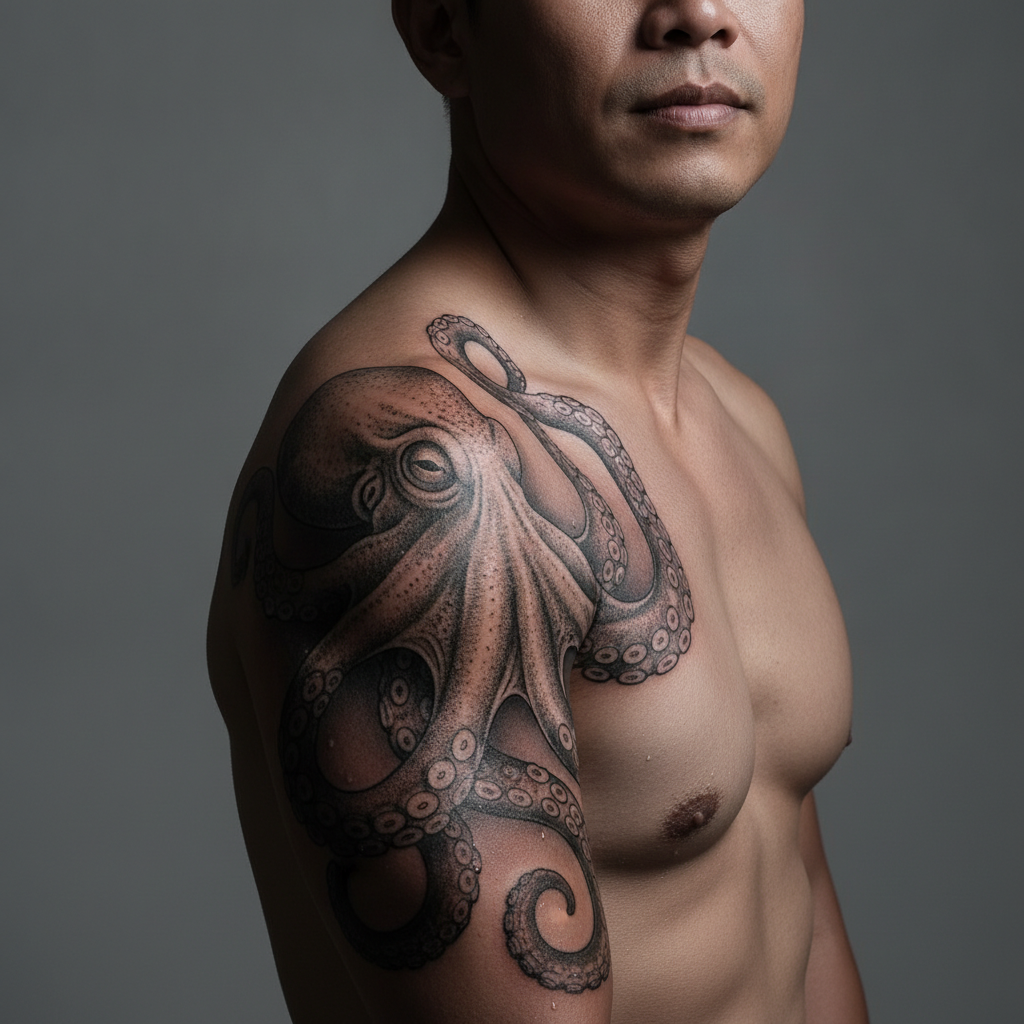
The animal you pick should match the shape of the body part. Long thin fish like eels, trumpetfish, and sea snakes work beautifully on forearms, calves, and spines because they follow the limb's natural line. Round subjects like puffer fish, jellyfish, and sea turtles need an area with enough surface to hold the full silhouette without wrapping awkwardly. Octopuses are the most versatile of the group because they adapt to almost any placement. The head can anchor on a shoulder blade with tentacles trailing down the arm, or sit on a thigh with tentacles curling around to the hip.
Koi fish deserve their own paragraph because they dominate the ocean-tattoo category even though koi are freshwater fish. The reason is Japanese irezumi tradition, where koi are rendered mid-swim with wave patterns, cherry blossoms, and water splash as support elements. A single koi with waves on the outer forearm runs 8 to 15 hours of work. A full half sleeve with koi, waves, maple leaves or cherry blossoms, and a wind-bar background sits at 25 to 40 hours spread across 3 to 6 sessions. For a deeper breakdown of what Japanese pieces cost from start to finish, the Japanese irezumi cost guide covers session structure and realistic budget ranges.
Nautical and old-school motifs
Anchors, compasses, swallows, nautical stars, mermaids, pin-up sailor girls, and ships make up the American traditional ocean canon. These designs were built for black outlines, limited color palettes of red, green, yellow, and blue, and large simple shapes that still read from across a room. Traditional ocean pieces age the best of any style in this category because the heavy outlines and solid fills were specifically engineered in the 1920s to survive decades on sun-exposed skin. A traditional anchor on the forearm, 3 to 5 inches tall, runs $300 to $600 and takes 2 to 3 hours.
Neo-traditional updates the same subjects with more detailed shading, broader color ranges, and tighter linework. A neo-traditional ship under storm clouds with waves and seabirds pushes into 6 to 10 hours of work and $900 to $2,400 in cost. The neo-traditional cost guide breaks down the hour and session count expectations in more detail. Both traditional and neo-traditional ocean work rewards a classic placement. Forearm, upper arm, thigh, and chest panels all handle the bold shapes well.
Placement choices for ocean compositions
Larger ocean scenes benefit from placements with enough surface area to carry the full narrative. Back pieces, chest panels, full sleeves, and thigh panels let you include multiple subjects, waves as connective tissue, and depth cues like ships in the distance or coral at the base. A full back piece with a diving mermaid, breaking wave, and shipwreck below runs 50 to 100 hours spread across 6 to 12 sessions, with total cost between $8,000 and $25,000 depending on artist and market.
Smaller single-element ocean tattoos work well on the ribs, calf, shoulder, or forearm. Forearm placements with waves or a small marine subject stay visible, which matters if visibility is part of the point for you. Ribs and calves hurt more during the session and heal with more peeling, so plan aftercare over joints and bony areas carefully if you pick those spots. Hand, foot, and finger ocean pieces exist and look great fresh but drop in resolution within 2 to 4 years because of constant friction and sun exposure, so budget for touch-ups every 3 to 5 years if you want them to stay crisp.
Common ocean subjects and their typical shape-fit for placement:
- Octopus: thigh, shoulder blade, upper arm, back panel
- Koi with waves: forearm, calf, half sleeve, side ribs
- Jellyfish: outer forearm, upper back, shoulder
- Shark: ribcage, outer calf, upper arm
- Compass or anchor: inner forearm, chest, upper arm
- Full wave scene: back, chest panel, thigh, outer bicep
Style and color decisions
Ocean subjects translate well into almost every tattoo style, which is both the fun part and the hard part of planning one. Blackwork turns waves into graphic negative-space statements and reads strong from day one through decade three. Fine-line gives small ocean subjects a delicate editorial feel but demands a lower-friction placement and more aggressive sun protection. Watercolor renders tide pools and jellyfish in painterly washes but fades faster than any other style, often needing refresh work by year five.
Full-color Japanese ocean work ages better than most people assume because the ink is laid in dense, saturated patches with clean black outlines that hold the shapes together even as the color softens. If you want a long-term color ocean piece, Japanese is the safest style bet. For color decisions in general, the color versus black-and-grey cost guide breaks down the time, cost, and longevity trade-offs with specific hour ranges.
A full Japanese back piece with waves is 50 to 100 hours of work and often takes 2 to 4 years to complete from first consultation to final touch-up.
Frequently asked
Which ocean tattoo subject ages the best over 15 to 20 years? Traditional American or Japanese ocean work with bold black outlines and solid color fills ages the best over 15 to 20 years. The outlines hold the shape even as pigment softens, and the solid fills resist fading better than thin shading or gradients. Fine-line and watercolor ocean pieces look stunning for the first 2 to 5 years but typically need significant touch-up or redraw work past year ten.
How much does a half sleeve of waves and marine life cost? A half sleeve covering roughly 25 to 40 hours of work runs between $2,500 and $6,000 at mid-tier artists charging $150 to $200 per hour. Top-tier Japanese specialists push $300 to $500 per hour, which brings a half sleeve into the $7,500 to $20,000 range. Deposits typically run $300 to $500 and apply toward the final session.
Do ocean tattoos fade faster because of sun and water exposure? Yes, especially if the piece is on a forearm, calf, or shoulder that sees daily sun. Chlorinated pools, salt water, and UV exposure all accelerate pigment breakdown. SPF 50 every day on the tattooed area adds years to the sharpness of the lines and the depth of the color. The long-term sunscreen aftercare guide covers application frequency and product choice for established tattoos.
Can I combine American traditional and Japanese elements in one piece? Combining styles in a single tattoo rarely works because the line weight, color palette, and composition rules are different. Running a traditional anchor next to a Japanese koi in the same panel usually looks like two tattoos touching rather than one unified piece. If you want multiple styles across the body, give each one its own placement with clear visual separation.
What is the right size for a first ocean tattoo? A first ocean tattoo in the 3 to 5 inch range on the forearm, calf, or outer bicep gives enough detail room to render a subject properly without committing to a multi-session plan. Pieces smaller than 2 inches lose fine detail within 5 years and often read as a shape rather than the specific subject. Starting mid-size also leaves room to expand into a sleeve or panel later if you decide to.
How long between sessions on a large ocean piece? Most artists schedule 4 to 8 weeks between sessions on a multi-session ocean piece. The skin needs full healing before the next pass, which typically takes 4 to 6 weeks for the surface layer and up to 3 months for full dermal recovery. Rushing sessions sooner than 4 weeks apart raises the risk of blowouts and scarring and makes the artist's job harder on the second pass.